Mortgage Protection Insurance: Is It Worth It for Homeowners?
It can be, but only in the right situation. Mortgage protection is most valuable when your household would struggle to keep the home if a wage earner died or became disabled, and when you want a simple plan that targets the mortgage balance. For many homeowners, a traditional term life insurance policy, properly sized and owned by the family, delivers equal or better protection with more flexibility and often a lower cost. The key is to compare the type of mortgage protection being offered, the price, the benefit structure, and whether the payout goes to your family or directly to a lender.
The fastest way to decide is to answer one question: if one income disappeared tomorrow, could your family pay the mortgage, plus taxes, insurance, and other essentials for at least 6 to 12 months while making long term plans? If the answer is no, then some form of protection is usually worth it. The next step is choosing the right tool.
What mortgage protection is supposed to do is simple, provide money so your survivors can keep the home or pay it off if you die, and sometimes if you become disabled. Where it gets confusing is that products sold as “mortgage protection” can be very different from one carrier to the next.
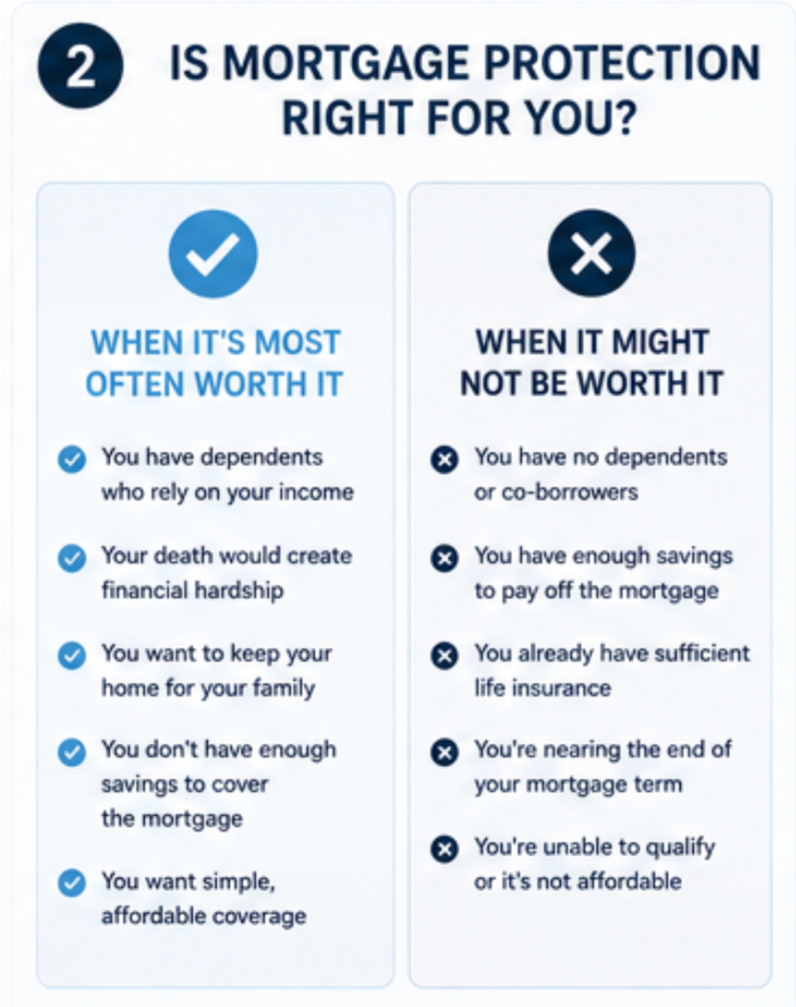
When Mortgage Protection Is Most Often Worth It?
- You recently bought a home and have a large mortgage relative to income.
- You are the primary earner, or your household depends on two incomes to qualify for the mortgage.
- You have little emergency savings and limited family support nearby.
- Your spouse or partner would have difficulty qualifying for a refinance on a single income.
- You have young children and want stable housing as part of your family plan.
- You have health conditions that make traditional term coverage harder to obtain, and simplified options are the only available path.
When it might not be worth it
- You already have enough term life coverage to pay off the mortgage and cover other needs.
- Your mortgage is small, nearly paid off, or affordable on one income.
- You have substantial savings and investments that could pay the loan balance.
- The policy offered is expensive for the benefit provided, especially if the payout decreases but premiums do not.
- The policy pays the lender directly and leaves no flexibility for your family.
Bottom line: Mortgage protection can be a smart part of your plan, but “worth it” depends on whether you buy the right structure and whether it fits your overall financial goals. The rest of this guide walks through what it is, how it works, what it costs, and how to choose between mortgage protection and alternatives.
What is mortgage protection insurance? Mortgage protection insurance is coverage designed to help pay off a mortgage, or at least make mortgage payments, if the insured person dies. Some versions also include disability protection, covering monthly payments for a period of time if you cannot work due to a covered disability.
Despite the name, it is not the same as private mortgage insurance, also called PMI. PMI protects the lender if you default. Mortgage protection is meant to protect your family’s ability to keep the home.
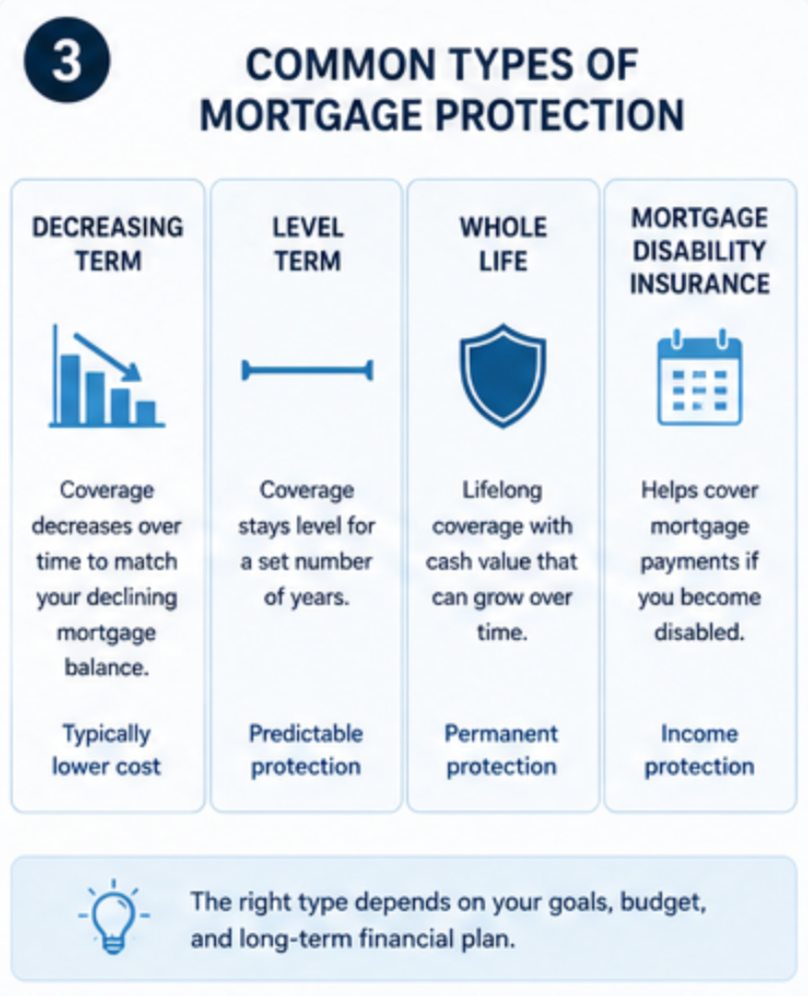
Common Types Of Mortgage Protection
- Decreasing term life insurance: the death benefit decreases over time, roughly matching a declining mortgage balance. Premiums are often level, meaning you may pay the same even as the benefit drops.
- Level term life insurance: the death benefit stays the same for a set term, such as 10, 15, 20, or 30 years. This is frequently used to protect a mortgage because it can cover the full balance plus other needs.
- Whole life or permanent life insurance: coverage can last for life if premiums are paid. It is often used for final expenses, wealth transfer, or long term family protection, and can also be used to protect a mortgage.
- Mortgage disability insurance: pays a monthly benefit toward the mortgage after a waiting period, often 30 to 90 days, for a limited benefit duration.
Who receives the payout? This is one of the biggest differences among offers. Some mortgage protection policies name the lender as beneficiary, so the money goes directly to the mortgage company. Others pay your chosen beneficiary, such as a spouse, who can decide whether to pay off the loan, keep cash for living expenses, or do a mix of both. Flexibility is usually better for families because life after a loss includes many expenses beyond the mortgage.
Why homeowners buy it? The emotional reason is stability. Grief is hard enough without the fear of losing a home. The financial reason is leverage. A mortgage is often the largest debt a household carries, and it is tied to a critical need: shelter. If you can remove or reduce that obligation during a crisis, your family’s cash flow becomes far more manageable.
How much coverage do you actually need? Many people assume they need exactly the mortgage balance. That is sometimes true, but not always. Consider the broader picture:
- If the insured person dies, will the surviving household need money for childcare, utilities, food, and transportation?
- Will property taxes and homeowners insurance still be due even if the mortgage is paid off?
- Are there other debts, such as car loans, credit cards, or student loans?
- Is there a need to replace income for a period of time?
For some families, the best plan is a level term policy large enough to cover the mortgage plus a cushion for income replacement and transition costs. For others, a policy sized to the mortgage payoff is the right and affordable target.
What does mortgage protection typically cost? Pricing depends on age, health, tobacco use, the term length, the coverage amount, and the underwriting type. As a general rule, fully underwritten level term coverage is often the most cost efficient per dollar of benefit for healthy applicants. Simplified issue, no medical exam style plans can be easier to qualify for, but are commonly more expensive because the insurer has less medical information.
Why some mortgage protection offers feel expensive
- The death benefit may decrease while the premium stays level, reducing value over time.
- Some plans are sold through direct mail or call centers with limited customization.
- Policies may be built with added fees or commissions that increase premiums.
- Coverage amounts may be small, but priced with a simplified underwriting approach.
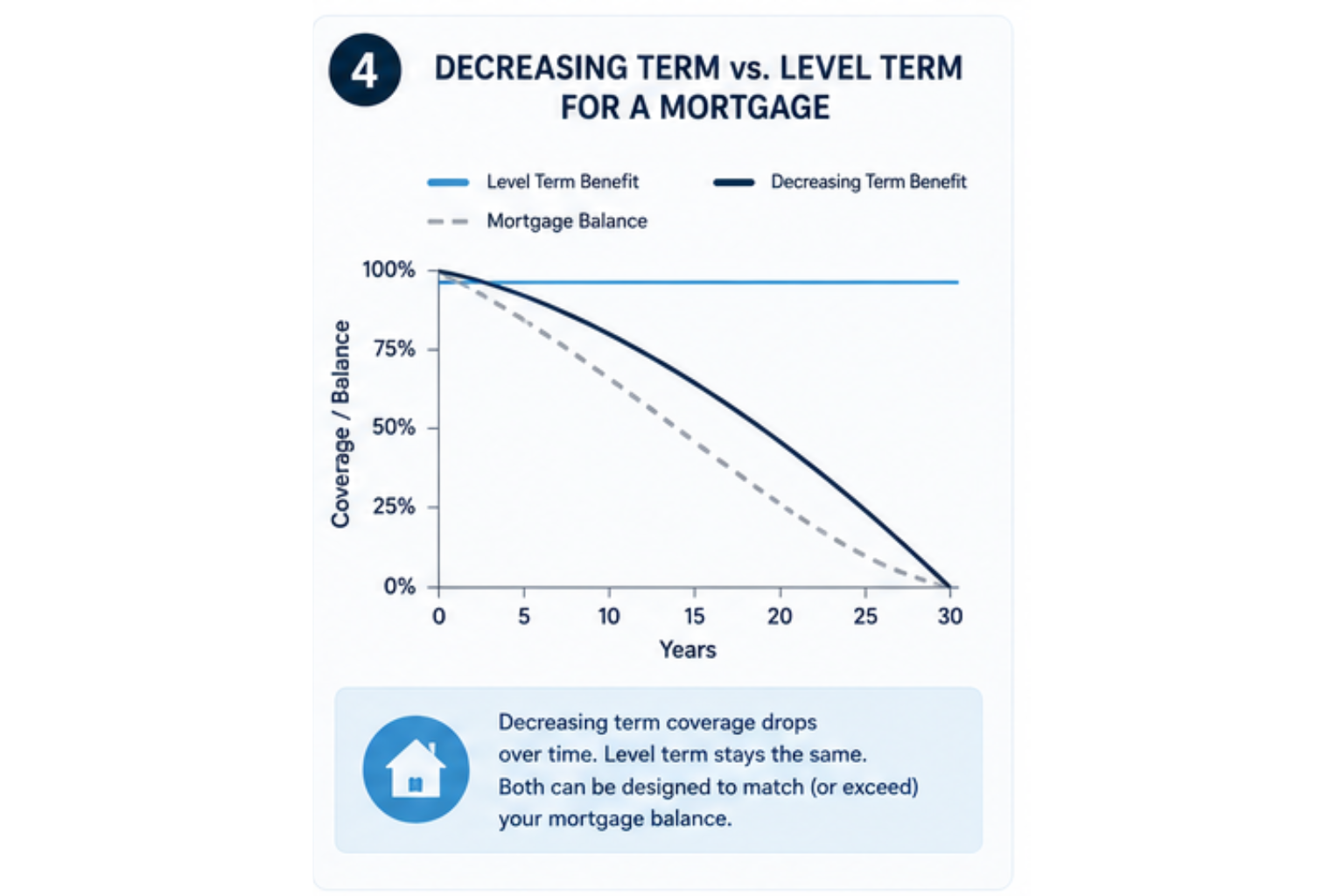
Decreasing term versus level term for a mortgage: Decreasing term can make sense when your only goal is mortgage payoff and you want a structure that tracks the loan balance. The tradeoff is that the benefit shrinks, even though your family’s overall cost of living usually rises with time due to inflation and life changes. Level term keeps the same death benefit throughout the term, which can provide a stronger safety net and more flexibility.
An important detail homeowners miss: Your mortgage payoff is not the same as your monthly payment. Even if a policy pays the mortgage balance, your family will still need cash for property taxes, homeowners insurance, maintenance, and possibly homeowners association dues. This is a strong reason many families choose a level term amount that exceeds the mortgage balance, or pair mortgage protection with broader life insurance planning.
Mortgage protection sold by a lender versus coverage you shop independently: Homeowners often first encounter mortgage protection through mailers or offers after closing. These programs can be legitimate, but you should understand what you are buying.
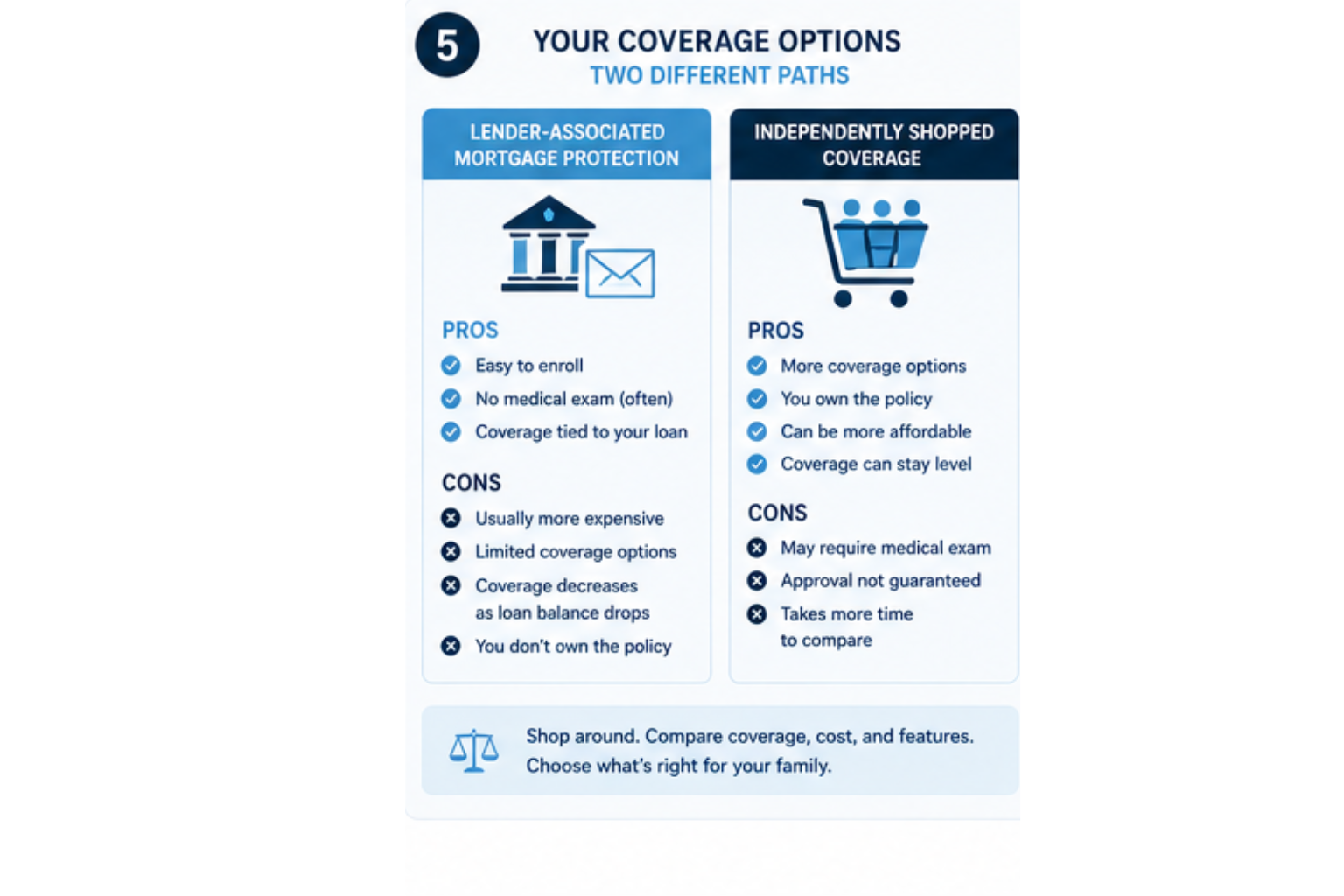
Lender associated mortgage protection pros:
- Convenience, you are offered coverage when the mortgage is new.
- Sometimes easier qualification than fully underwritten coverage.
- Clear intent, the benefit is designed around the mortgage.
Lender associated mortgage protection cons:
- Less comparison shopping, so you may overpay.
- Benefit may be designed to pay the lender directly.
- Coverage may be tied to the mortgage terms, not your full family needs.
- Terms and exclusions may be less visible at the point of sale.
Independently shopped coverage pros:
- Ability to compare multiple A rated carriers and product types.
- Freedom to choose your beneficiary and how funds are used.
- Better alignment with a full financial plan, not only the mortgage.
- Potentially lower cost, especially for healthy applicants.
Independently shopped coverage cons:
- May require an exam or more detailed health questions for best rates.
- More decisions to make, such as term length and amount.

Key features to review before you buy: Mortgage protection can be worth it only if the policy does what you think it does. Review these items carefully:
- Benefit type: level or decreasing, and how the decreasing schedule works.
- Beneficiary: your family, your trust, or the lender.
- Term length: does it match how long you expect to carry the mortgage?
- Premium structure: level premiums or increasing with age.
- Underwriting: fully underwritten, simplified issue, or guaranteed issue.
- Waiting periods: common in some simplified policies, especially for certain causes of death early in the policy.
- Exclusions: understand what is not covered.
- Conversion options: whether you can convert term coverage to permanent coverage later without a new medical exam.
Mortgage protection with disability coverage: what to know? Some homeowners want protection not only for death but also for the risk of losing income due to disability. This can be valuable, but read the details. Mortgage disability plans often include a waiting period before benefits start, and they may cap the benefit duration. They also typically define disability in a specific way. If your goal is broader income protection, a standalone disability income policy may offer stronger coverage, though it can be more expensive and may involve stricter underwriting.
Mortgage protection versus term life insurance: This is the most common comparison. If you are healthy enough to qualify, term life insurance is often the most straightforward way to protect a mortgage because it is flexible and usually cost effective.
How Term Life Can Be Superior For Homeowners
- Payout goes to your beneficiary, not automatically to the lender.
- You can choose a coverage amount that includes the mortgage and other needs.
- Level term benefits do not shrink over time.
- You can align the term length to the mortgage, such as a 30 year term for a new 30 year loan.
When Mortgage Specific Coverage Can Still Win
- You want a decreasing structure because it matches the balance and you prefer a smaller benefit later.
- You cannot qualify for competitively priced fully underwritten term, and a simplified mortgage protection plan is available at a manageable cost.
- You want an add on disability benefit tied specifically to your mortgage payment.
Mortgage protection versus paying extra principal: Paying extra principal is great for long term interest savings and building equity. It is not a substitute for insurance in the early years of a mortgage, because the risk event you are protecting against is immediate, and extra principal builds slowly. Insurance transfers the risk of a large loss to an insurer right away. Many homeowners do both, they carry term coverage and also pay extra principal when cash flow allows.
Mortgage protection versus an emergency fund: An emergency fund is essential, but it is usually designed for short term disruptions, such as job loss or unexpected repairs. Life insurance is designed for high severity events like death. If you have a large emergency fund that could cover years of mortgage payments and living costs, you may need less insurance. Most households do not, especially soon after purchasing a home.
How inflation and life changes affect the decision: A fixed mortgage payment can become more affordable over time as income rises, but other housing costs often increase. Taxes and insurance can rise, and maintenance gets more expensive. Families also change, with children, college costs, caregiving, or career changes. A flexible payout, such as a term life benefit paid to a spouse, gives options to handle those realities.
Choosing the right term length: The term should reflect how long the financial risk exists. For mortgage protection, that is usually until the mortgage is paid off or until your household would be financially secure even without the insured person’s income.
- 30 year term: common for new homeowners with a new 30 year mortgage and young families.
- 20 year term: common when the mortgage is partially paid down, or when retirement is closer.
- 10 to 15 year term: common for late stage mortgages or higher income households with strong savings.

Should both spouses be insured? Often yes, especially when both contribute income or critical unpaid labor such as childcare. If a stay at home parent dies, the surviving spouse may need to pay for childcare, housekeeping, and other services, and may also need time off work. Mortgage protection planning should account for both roles, not only income.
How underwriting affects homeowners: Underwriting is the insurer’s process for pricing risk. Fully underwritten policies usually ask detailed medical questions and may include an exam. Simplified issue policies ask fewer questions and often do not require an exam. Guaranteed issue policies have minimal health questions, but are typically the most expensive per dollar of coverage and may include graded benefits at the start.
If you are a homeowner with health concerns, your best move is to compare carriers. Different insurers treat different conditions differently. This is where an independent agency can help, because you are not limited to one company’s underwriting appetite.
Common Misconceptions
- Misconception: “My mortgage company requires mortgage protection.”
- Reality: lenders require homeowners insurance, and sometimes PMI, but they usually do not require mortgage protection life insurance.
- Misconception: “Mortgage protection is the same as PMI.”
- Reality: PMI protects the lender, mortgage protection is meant to protect your family.
- Misconception: “A decreasing benefit is always best for a mortgage.”
- Reality: decreasing benefits can leave less money for surviving family needs over time.
- Misconception: “Any life insurance will automatically pay off the mortgage.”
- Reality: life insurance pays your beneficiary, who then chooses how to use it unless a lender is named beneficiary.
A Practical Homeowner Checklist
Use this list to decide whether mortgage protection is worth it and what to buy.
- Write down your current mortgage balance, interest rate, remaining years, and monthly payment.
- Estimate monthly housing costs including taxes, insurance, and HOA dues.
- Calculate how long your savings could cover all essential bills.
- Decide whether the priority is paying off the home, covering payments, or both.
- Determine who would receive the benefit and how quickly you want funds available.
- Compare at least two structures, decreasing term mortgage protection and level term life insurance.
- Confirm whether premiums are level and whether the benefit changes over time.
- Review policy exclusions and any waiting period or graded benefit language.
- Revisit the plan after major life events, new baby, refinance, income change, or a move.

Example Scenarios: When it is worth it?
Scenario 1: New family with a new mortgage Two parents buy a home with a 30 year loan. They have limited savings after closing costs. If one parent dies, the other cannot cover the mortgage and childcare alone. In this case, mortgage protection is usually worth it. Many families in this situation choose level term insurance sized to cover the mortgage and add income replacement for several years.
Scenario 2: Single homeowner with co signer risk A single homeowner has a parent as a co signer or has a partner living in the home who is not on the mortgage. If the homeowner dies, the surviving household could face immediate housing disruption. A policy that pays a flexible benefit to the chosen beneficiary can protect the home and reduce stress for everyone involved.
Scenario 3: Near retirement with a small remaining balance A homeowner has 7 years left on a mortgage and strong retirement savings. The mortgage payment is manageable on one income and the household has a large emergency fund. In this case, mortgage protection may not be necessary, or a smaller policy could be enough. The decision may shift toward legacy planning or final expense planning instead of mortgage payoff.
How to avoid overbuying: Overbuying happens when coverage is purchased without coordinating with existing policies or without understanding what the benefit does. To avoid it, inventory your current life insurance through work, individual policies, and any group coverage, then decide what gap remains. Also consider that employer coverage can change if you leave a job, so homeowners often prefer at least some personally owned coverage.
How Life Insured By Chris Approaches Mortgage Protection
Life Insured By Chris was founded to bring clarity, choice, and confidence to life insurance. For homeowners, that means starting with your goal, keeping the home, paying it off, or protecting cash flow, then comparing options across multiple A+ rated carriers. Because we are not tied to one company, we can evaluate whether a mortgage specific product is actually best, or whether a level term policy, or a blend of term and permanent coverage, provides better value for your family’s situation.
Questions To Ask Before You Sign An Application
- Is the death benefit level or decreasing, and what will it be in year 5, year 10, and year 20?
- Are premiums guaranteed level for the entire term?
- Who is the beneficiary, and can I change it later?
- Is there a waiting period or graded benefit for natural causes?
- Can the term policy be converted to permanent coverage later?
- How does this policy coordinate with my employer life insurance?
- What happens if I refinance, move, or pay off the mortgage early?
Frequently Asked Questions
Is mortgage protection the same as homeowner's insurance? No. Homeowner's insurance covers damage to the home and liability risks. Mortgage protection is about paying the mortgage if you die, and sometimes if you become disabled.
Do I need mortgage protection if I already have life insurance? Maybe not. If your existing life insurance is enough to cover the mortgage and other needs, mortgage protection could be redundant. The right move is to measure the gap, not buy a second policy by default.
Should I name the lender as beneficiary? Usually, families benefit from naming a spouse, trust, or another person. That preserves flexibility. Naming a lender can be appropriate if your goal is guaranteed payoff and you have strong cash reserves for everything else, but many households prefer control.
Is a 20 year term enough for a 30 year mortgage? It can be if you expect to build savings and equity and reduce risk by year 20. If your budget allows and you want maximum stability, matching the term to the mortgage is often the simplest approach.
Final guidance: Mortgage protection insurance is worth it when losing an income would threaten your ability to stay in the home, and when the policy structure fits your real needs. For many homeowners, the best value is a level term life insurance policy that is personally owned, competitively priced, and large enough to cover the mortgage plus a cushion for life expenses. For others, a mortgage specific plan can be the right solution, especially when health makes other coverage difficult. The best next step is to compare multiple options side by side, focusing on benefit structure, beneficiary control, term length, and total cost.
| Ready to compare your options? We'll shop more than 30 top-rated carriers to help you find the right life insurance, whether a no-exam policy or traditional underwriting is the better fit. → Visit: https://myagentisverified.com/Calendar/lifeinsuredbychris |