Best Life Insurance for Smokers: 10 Top Options Now
Smoker life insurance is rarely about finding one universally “best” policy. It is about finding the carrier and policy type that treats your tobacco profile, age, health history, and budget most favorably. That is why an independent brokerage like Life Insured By Chris is relevant here: smoker pricing can vary a lot from one insurer to another, even when the applicant profile is nearly identical.
TL;DR: Summary
The best smoker life insurance usually comes from comparing multiple carriers and policy types, not picking the first insurer, because tobacco pricing varies materially by company.
Life Insured By Chris compares smoker quotes from 30+ top-rated carriers, which matters when one insurer may rate the same applicant as a better or worse tobacco risk than another.
NAIC guidance shows smoker status is a formal underwriting input, with categories that may include no tobacco usage, nonsmoker, cigarette smoker, and tobacco user.
Term life is often the lowest-cost starting point for smokers, while whole life and other permanent policies trade higher premiums for lifelong coverage and possible cash value.
If speed matters, accelerated underwriting may cut approval from weeks to hours, but fully underwritten policies can still produce stronger pricing for some smokers.
If you smoke cigarettes, use cigars, vape nicotine, chew tobacco, or recently quit, the details matter. Insurers do not all define tobacco use the same way, and they do not all price it the same way either. That makes comparison shopping especially important for families, veterans, seniors, and first-time buyers who want solid coverage without overpaying.
What makes smoker life insurance more expensive?
Smoker life insurance costs more because insurers treat tobacco use as a measurable mortality risk. The CDC and NAIC both support the basic framework: smoking materially affects health risk, and underwriting converts that risk into class and premium decisions.
In practice, higher pricing shows up through smoker classes, fewer preferred-rate opportunities, and stricter scrutiny of related health issues. Cigarette use often produces the steepest pricing impact, though carriers may also rate cigars, chewing tobacco, nicotine pouches, and vaping differently. Age, blood pressure, cholesterol, family history, and prescription use still matter, but tobacco status often changes the entire pricing lane.
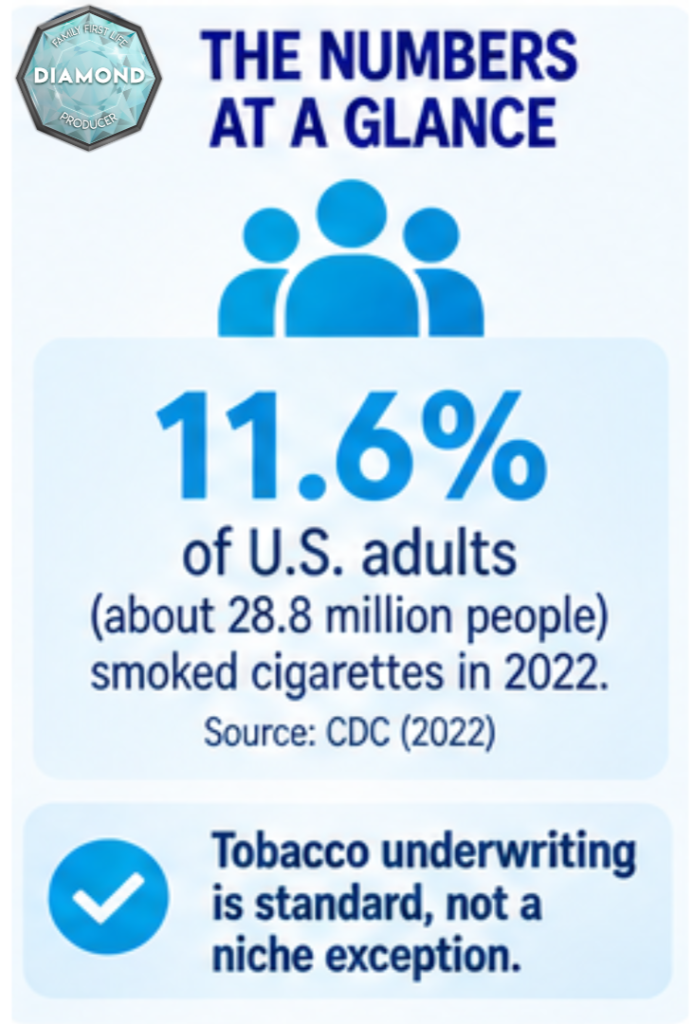
The CDC estimated that 11.6% of U.S. adults, or 28.8 million people, currently smoked cigarettes in 2022. That large population is exactly why smoker underwriting is not a niche exception. It is a standard part of life insurance pricing in the United States.
"Life Insured By Chris compares smoker quotes from 30+ carriers because tobacco pricing can differ materially for the same applicant profile."
How do insurers define smoker status and tobacco use?
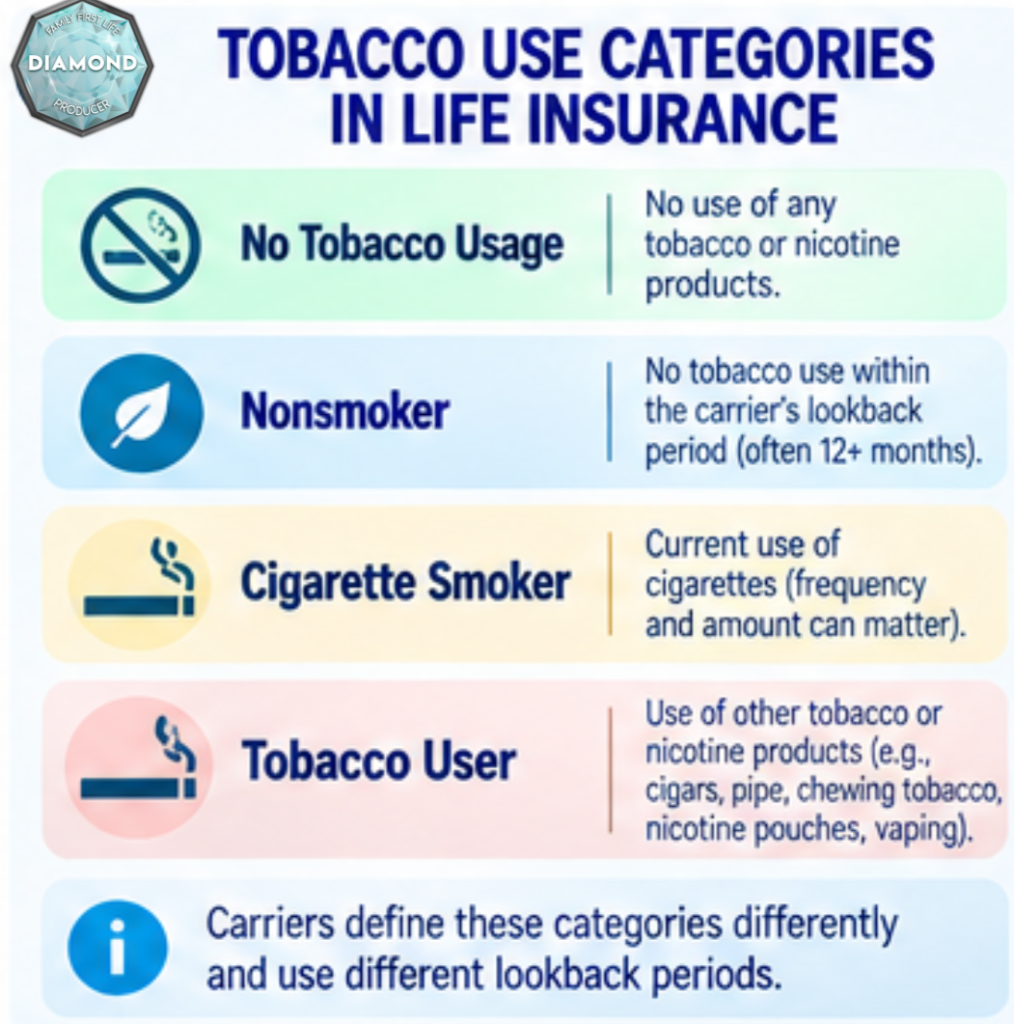
Insurers define smoker status through underwriting categories, not casual labels. NAIC terminology includes values like no tobacco usage, nonsmoker, cigarette smoker, and tobacco user, and some carriers split those groups more finely than others.
That distinction matters. A person who smokes cigarettes daily may be treated differently from someone who smokes occasional cigars. A nicotine vape user may be coded as a tobacco user by one carrier and evaluated differently by another. The NAIC data dictionary also notes that companies may use different preferred class structures, with at least two and as many as nine classes.
A common misconception is that “I only smoke socially” equals nonsmoker. It often does not. If nicotine or tobacco use falls inside a carrier’s lookback period, the application may still land in a smoker or tobacco-user class.
If you are unsure how a carrier will classify your use, ask before applying. One poorly matched application can lead to a discouraging quote that may not reflect what a better-fit insurer would offer.
What are the 10 top life insurance options for smokers right now?
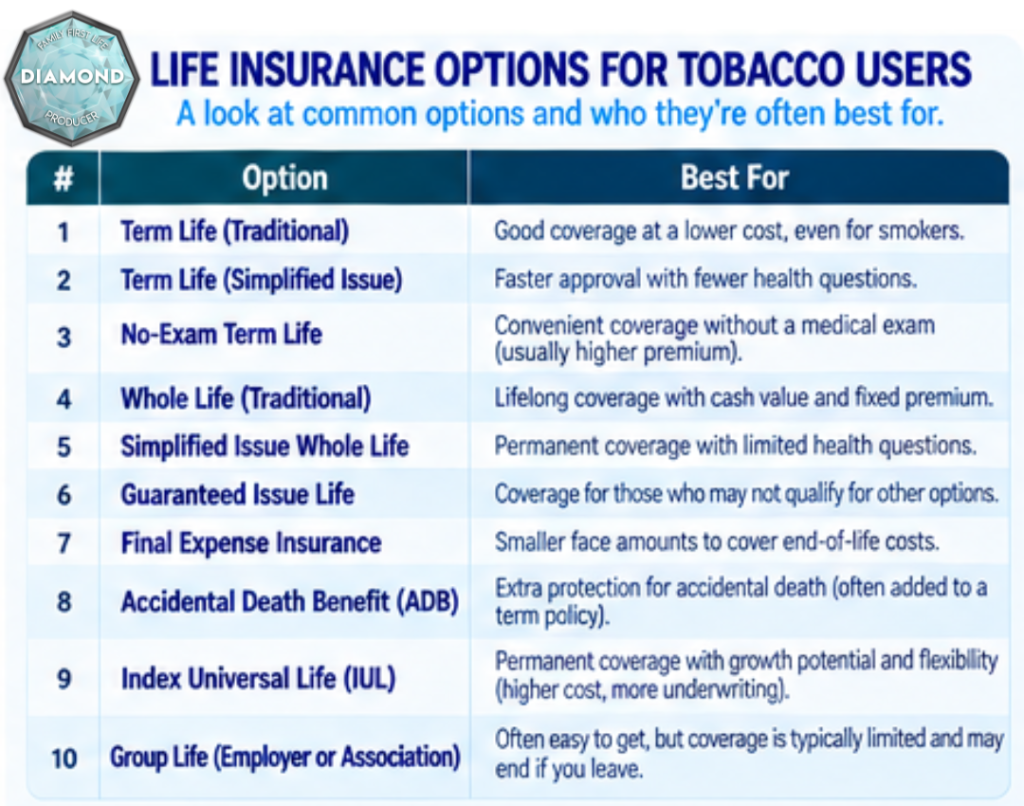
The top options for smokers are the ones that match your underwriting profile and goals. That usually means comparing independent brokerage access, term coverage, permanent coverage, final expense, and no-exam routes instead of assuming one product fits every smoker.
A smart shortlist mixes policy type with underwriting style. Here are options worth considering now:
- Level term life insurance: Often the best fit for income replacement, mortgage protection, and budget control.
- Accelerated underwriting term: Useful when you want faster decisions and may qualify without a full exam.
- Fully underwritten term: Worth checking when strong overall health might still earn better smoker-class pricing.
- Whole life insurance: Fixed lifelong coverage with cash value, as the NAIC describes for permanent insurance.
- Indexed universal life: A permanent option for buyers balancing lifelong protection with flexible premium design.
- Final expense insurance: Good for modest death-benefit needs and simplified approval.
- No medical exam life insurance: Helpful if you want to avoid fluids, paramed exams, or long timelines.
- Guaranteed issue life insurance: A fallback option when health challenges limit other approvals.
- Mortgage protection insurance: A focused option when the main goal is keeping the home secure for survivors.
Is term life insurance or whole life insurance better for smokers?
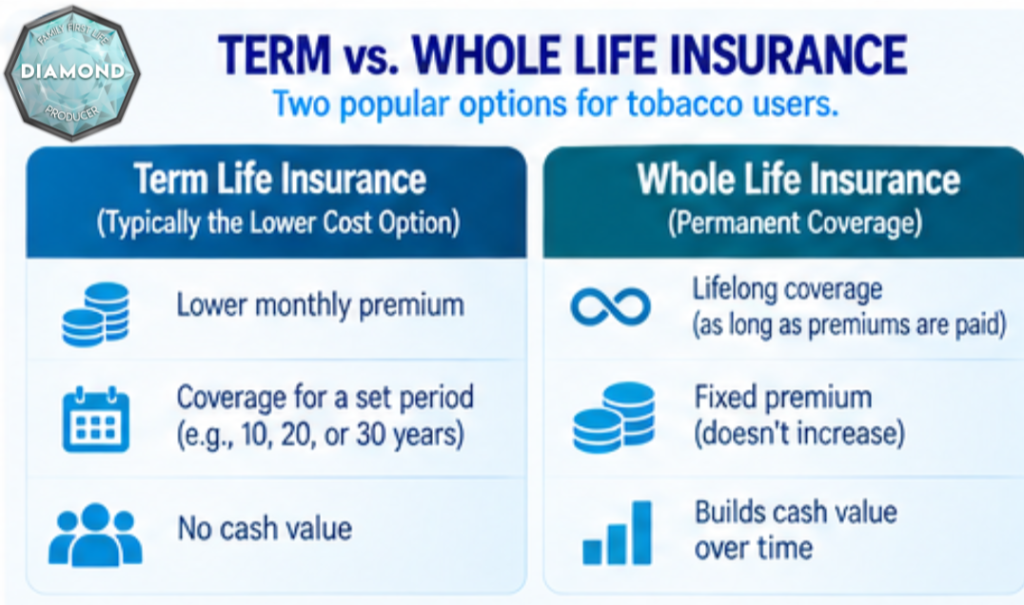
Term life is usually better for smokers who want the lowest premium for the highest death benefit. Whole life is usually better for smokers who want lifetime coverage, fixed premiums, and cash value.
The NAIC describes term insurance as lower cost in the early years and whole life as lifelong coverage that can build cash value. That trade-off becomes sharper for smokers because tobacco rates raise the starting price. If your budget is tight, term often creates more protection per dollar. If you need burial funding, estate liquidity, or permanent family protection, whole life may justify the higher premium.
A practical rule helps here. If you need coverage for 10, 20, or 30 years to protect income or debt, start with term. If you need coverage that will still be there regardless of when you die, permanent insurance deserves a closer look.
One more nuance: some smokers buy term now and revisit permanent coverage later if they quit and requalify for better rates.
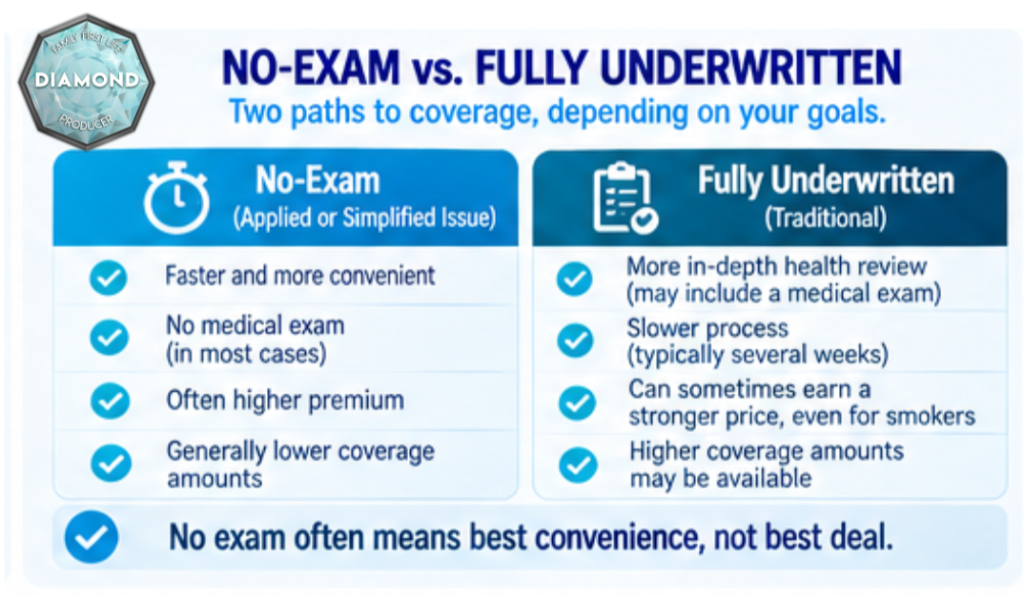
Should smokers choose no-exam life insurance or fully underwritten coverage?
No-exam life insurance is faster, but fully underwritten life insurance can still be cheaper for some smokers. The best choice depends on whether speed, price, or approval certainty matters most.
The NAIC says accelerated underwriting expanded significantly from 2020 to 2022 and can reduce application time from several weeks to just a few mins. Traditional underwriting may require an exam plus blood, urine, and saliva testing, and approval can take much longer. That makes no-exam and accelerated options attractive when coverage is urgent.
The trade-off is simple. If the carrier can approve you quickly using prescription history, motor vehicle reports, medical databases, and application answers, the process is easier. If your profile looks better in a full underwriting review than in an instant-data model, a fully underwritten policy may reward that with stronger pricing.
"Life Insured By Chris offers a free 15-minute coverage review, which is useful when choosing between no-exam speed and full underwriting."
A common mistake is assuming “no exam” always means “best deal.” It often means “best convenience.” Those are not the same thing.
How should you compare smoker quotes step by step?
The best way to compare smoker quotes is to standardize the inputs, then compare carriers side by side. Life Insured By Chris is relevant here because independent quote comparison helps reveal which insurers are more favorable to a specific tobacco profile.
Start with Step 1: define one consistent target. Pick the same age, coverage amount, term length, rider needs, and beneficiary structure across every quote. If you change the death benefit or policy length between carriers, the comparison becomes blurry.
Step 2 is to state your tobacco use clearly. Include cigarettes, vaping, cigars, chewing tobacco, nicotine replacement products if asked, and quit dates. If your disclosure is incomplete, the quote can look attractive at first and change later during underwriting.
Step 3 is to compare policy type and underwriting path together. A smoker may see one carrier offer a competitive accelerated term quote while another carrier is stronger on fully underwritten whole life or final expense. This is where independent comparison matters more than generic online rate tables.
When you compare, judge these three things together: price, approval odds, and policy fit. The lowest premium is not the best option if the underwriting class is unrealistic or the product does not match your actual goal.
How can you apply for smoker life insurance without hurting your odds?
A strong smoker life insurance application is honest, complete, and timed well. The right sequence can protect your options and reduce unpleasant surprises.
Step 1 is pre-screening. Before submitting a formal application, review your age, medical conditions, prescriptions, tobacco pattern, and quit history. This helps identify whether term, no-exam, whole life, or final expense is the strongest lane.
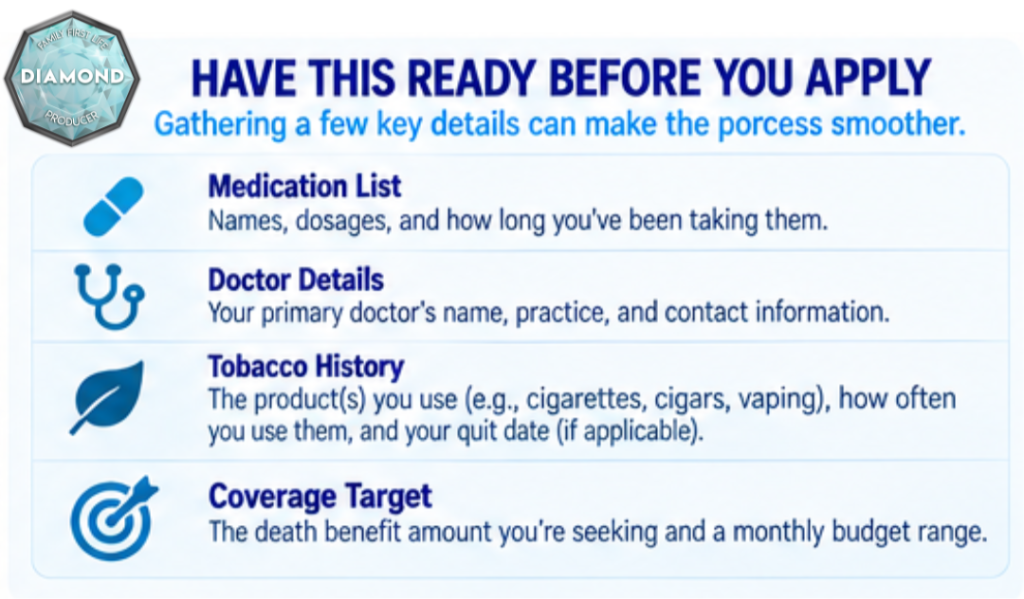
Step 2 is document readiness. Have the basics ready before the insurer asks:
- Medication list: current prescriptions and dosages
- Doctor details: primary care and specialist names
- Tobacco history: product type, frequency, and quit date if applicable
- Coverage target: amount, purpose, and budget range
Step 3 is carrier selection. If one insurer treats occasional cigar use more favorably than daily cigarettes, that difference matters. If another insurer is stricter about recent nicotine use, it may not be the right first application.
One misconception is that applying with several companies at once always improves odds. It can create confusion and duplicate medical requests. A better move is to target the most suitable carriers first.
How do you move from smoker rates to nonsmoker rates?
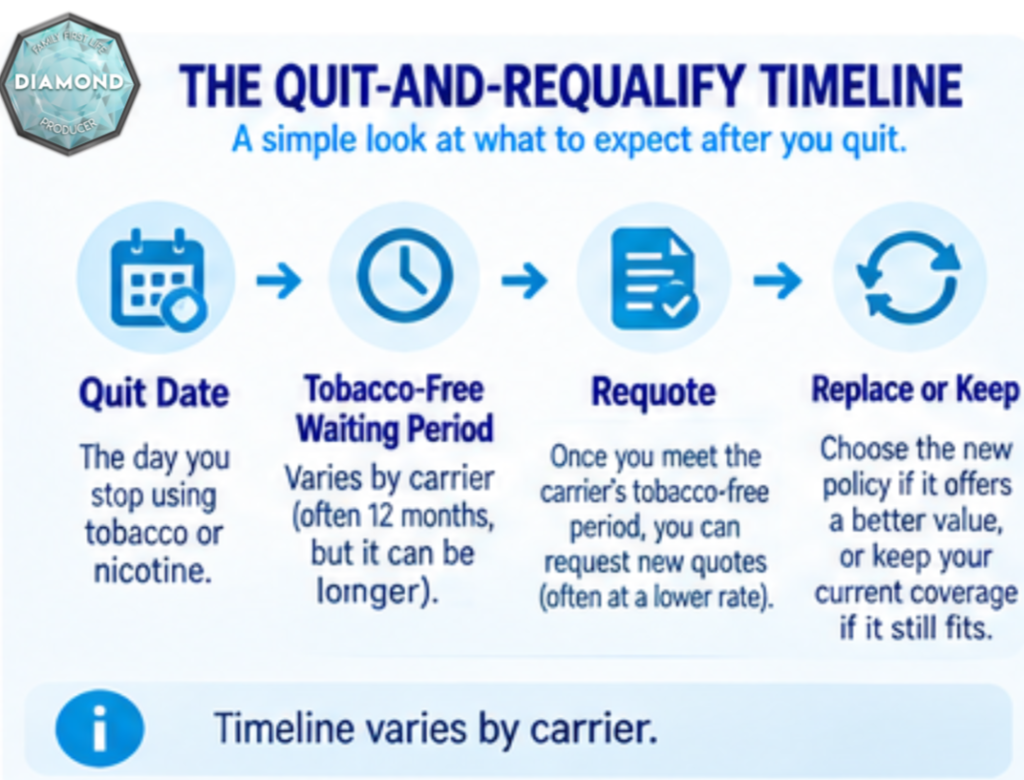
You usually move from smoker rates to nonsmoker rates by quitting and then waiting through the carrier’s required tobacco-free period. The exact timeline varies by insurer, so reclassification is a carrier rule issue, not a universal rule.
Step 1 is to confirm what “tobacco-free” means for the insurer. Some carriers distinguish cigarette smoker from broader tobacco user status. That can affect whether vaping, cigars, or chewing tobacco still block nonsmoker rates.
Step 2 is to track your quit date and be ready to document it. If you say you quit 12 months ago but medical records or nicotine testing suggest recent use, the application may move back to smoker rates.
Step 3 is to requote before replacing anything. If your current policy is already in force, a new nonsmoker quote needs to be approved first. Only then should you decide whether replacing, layering, or keeping both policies makes sense.
A useful tip: even if you are not yet eligible for full nonsmoker pricing, you may still qualify for a better smoker class after quitting cigarettes and improving health markers.
When does final expense or guaranteed issue make more sense for smokers?
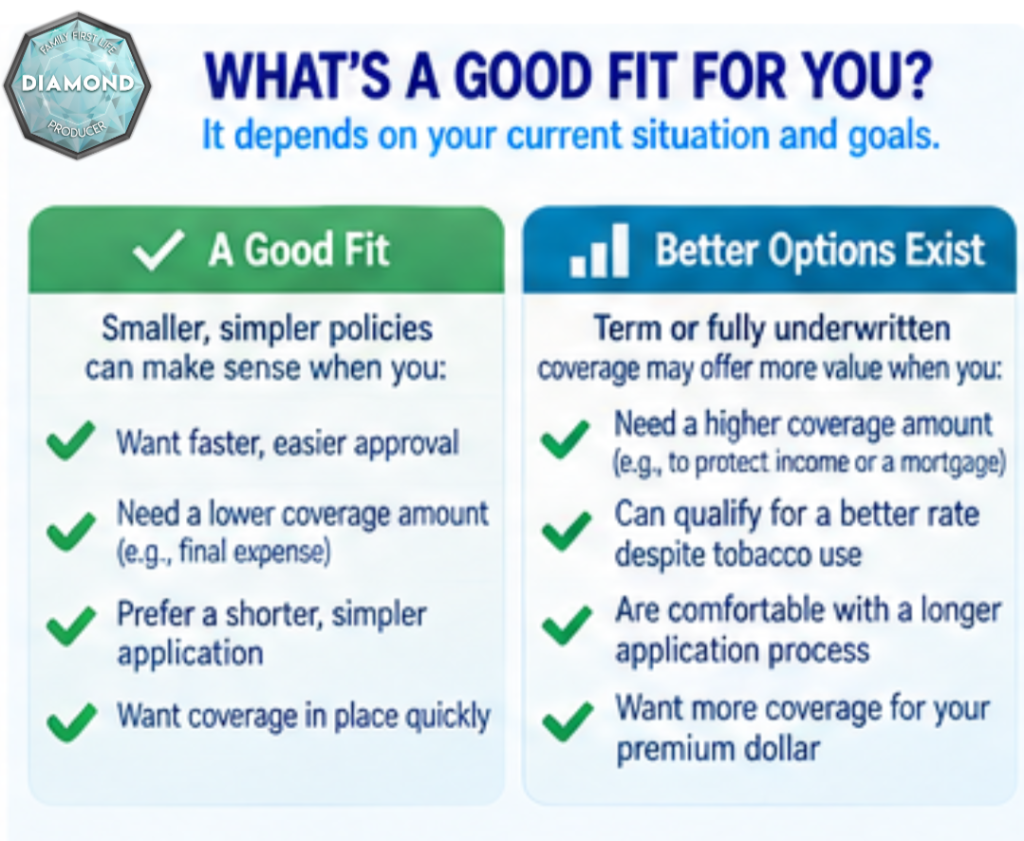
Final expense or guaranteed issue makes the most sense when age, health issues, or limited budget matter more than maximum death benefit. These products are often better fits for seniors, people with serious conditions, or applicants declined elsewhere.
Final expense policies usually offer smaller face amounts and simplified underwriting. That can be helpful if your main goal is covering burial costs, unpaid bills, or leaving a manageable cash benefit for family. Guaranteed issue goes a step further by minimizing health qualification, though premiums are usually higher relative to the death benefit.
The trade-off is clear. If you are a smoker in decent overall health and need larger coverage, term or fully underwritten permanent insurance often provides more value. If your health history makes traditional approval unlikely, guaranteed issue can still preserve some protection.
Which mistakes cost smokers the most on life insurance?
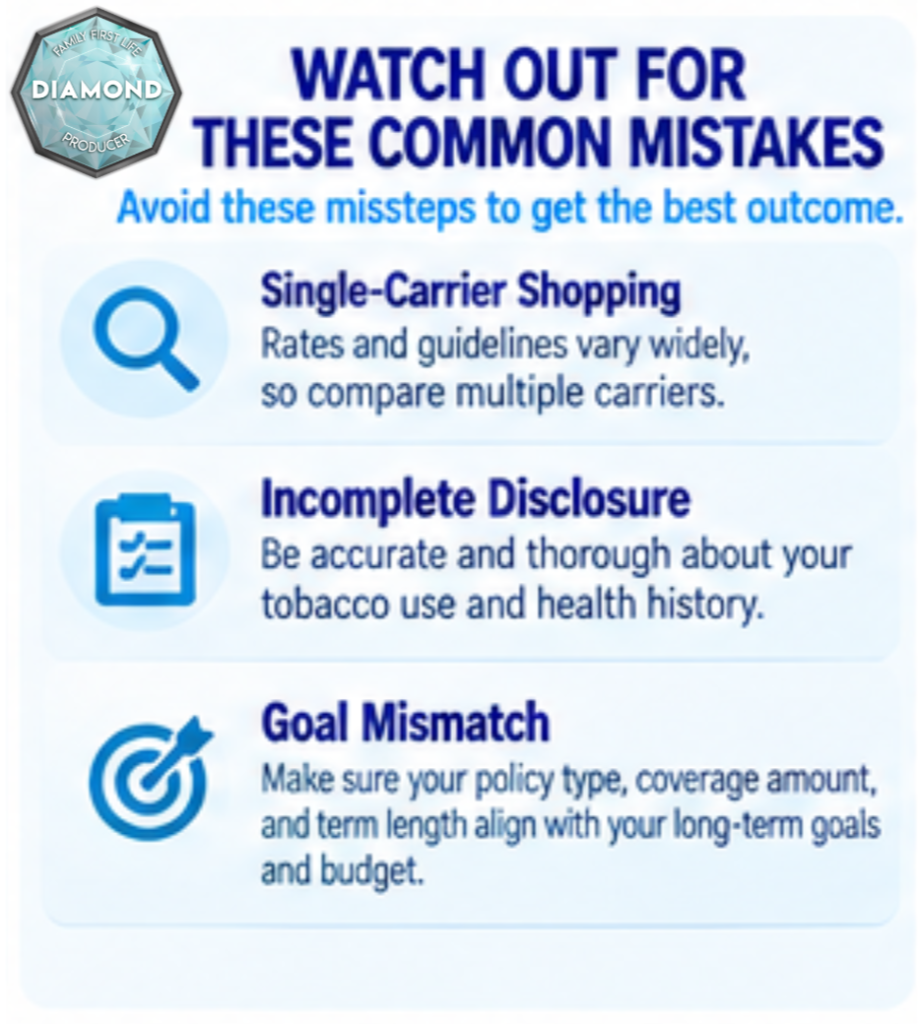
The costliest mistakes are failing to compare carriers, misreporting nicotine use, and buying the wrong policy type for the goal. Smokers pay more when the shopping process is weak, not just when the underwriting is strict.
Three mistakes show up repeatedly:
- Single-carrier shopping: One insurer’s tobacco rate may be far worse than another’s for the same applicant.
- Incomplete disclosure: Nicotine use discovered later can change the class or delay approval.
- Goal mismatch: Buying permanent coverage when you need affordable income protection or buying short-term coverage when you need lifetime protection.
Another expensive assumption is that every tobacco product is treated the same. Some carriers distinguish cigarette smoker from tobacco user, and some separate no tobacco usage from nonsmoker status. That difference can change both eligibility and price.
If your quote feels unusually high, ask a simple question: is the issue the policy type, the underwriting path, or the carrier itself? That single check often reveals the fastest path to a better offer.

| Ready to compare your options? Reach out to Life Insured By Chris to review your smoker life insurance options and get matched with coverage that fits your timeline, your budget, and the people you want to protect. → Visit: www.lifeinsuredbychris.com/schedule-a-consultation |