Using Life Insurance to Build Wealth: A Practical Roadmap Beyond the Death Benefit
Using Life Insurance to Build Wealth: A Practical Roadmap Beyond the Death Benefit
Most people buy life insurance for one reason: to replace income if they die. That is the right starting point, but it is also where many families stop thinking. The problem is not that a death benefit is unimportant. The problem is that when life insurance is treated as a simple checkbox, you can miss opportunities to strengthen your financial life while you are alive, and you can also fall for poor advice that treats life insurance like a magic investment. Wealth building with life insurance is real, but only when you understand what it is, what it is not, and how to design it responsibly.
This article is written like the conversations we have with clients at Life Insured By Chris. It is an opinionated, practical roadmap. My position is simple: life insurance should first protect your family. After that, certain types of permanent life insurance can become a conservative wealth tool, especially for people who value tax planning, stability, and liquidity on their own terms.
The Core Problem: People Want “Wealth” But They Buy Insurance Without a Plan
When someone says, “I want to use life insurance to build wealth,” they usually mean one or more of these goals: they want money that grows with less tax friction, access to cash for opportunities, protection from market volatility, a legacy that transfers efficiently, or a tool that plays nicely with business and estate planning. The mistake is trying to force one policy to do everything fast. Another common mistake is buying an under-designed permanent policy with premiums that strain cash flow, then cancelling it during the expensive early years. The wealth-building story only works when the policy is designed for your goals, funded consistently, and held long enough for the math to become favorable.
So the solution is not “buy whole life” or “buy IUL.” The solution is a sequence: protect first, build a stable foundation, then consider cash value insurance as one of several coordinated wealth tools.
Start With a Clear Definition: What Life Insurance Can Do For Wealth?
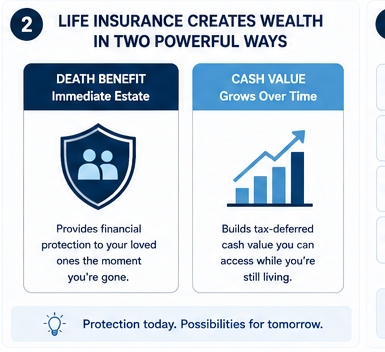
Life insurance can create wealth in two distinct ways. First, it creates an immediate estate by leveraging premiums into a death benefit. That is the classic purpose and it is still the most powerful leverage most families will ever buy. Second, some permanent life insurance policies can build cash value, which may grow tax-deferred, may be accessed through withdrawals or policy loans, and may provide optional riders for chronic illness or long-term care needs, depending on the policy.
Notice what we did not say. We did not say it is the best investment. We did not say it will beat the stock market. We did not say it is “tax-free” in every situation. Wealthy households tend to use life insurance as a complement to investing, not a replacement for it. It can be a private, contract-based asset with unique tax treatment, but it is not a shortcut around disciplined saving and investing.
Step 1: Build The Protection Foundation Before Chasing “Infinite Banking” Slogans
If your household has limited cash flow, high-interest debt, or no emergency fund, a cash value policy is often the wrong first move. In most cases, you start with term life insurance to cover the years when losing income would be catastrophic. Term insurance can be efficient and affordable, and it frees up dollars for debt payoff, emergency reserves, and retirement contributions. This is not anti-wealth, it is how you keep a wealth plan from collapsing in a crisis.
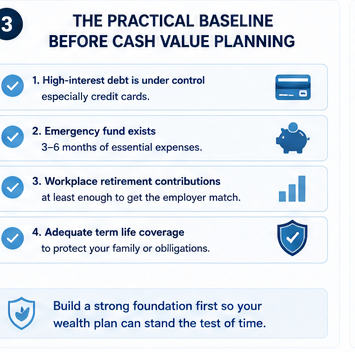
Here is my practical baseline before serious cash value planning, not a hard rule, but a strong filter.
- High-interest debt is under control, especially credit cards.
- Emergency fund exists, typically three to six months of essential expenses.
- Workplace retirement plan contributions are at least high enough to capture any employer match.
- You have the right amount of term coverage to protect your family or business obligations.
If you are not there yet, you can still plan ahead. Just do not force permanent insurance into a cash flow that cannot support it.
Step 2: Understand The Three Common “Wealth” Policy Families
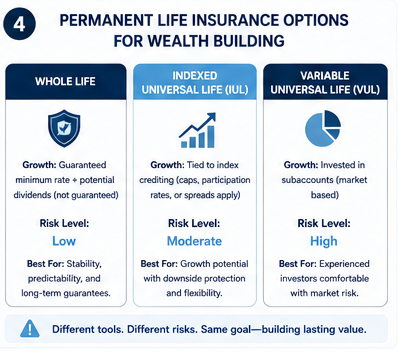
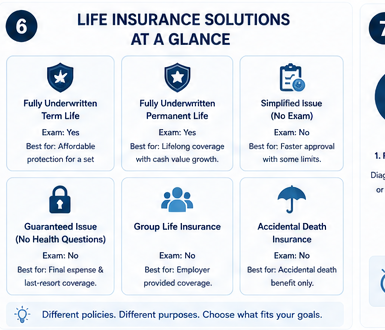
There are multiple types of permanent life insurance, but most wealth conversations land in three buckets: whole life, indexed universal life, and variable universal life. Each can be appropriate, and each can be inappropriate. The key is aligning expectations with how the policy actually works.
- Whole life: Typically offers guaranteed premiums, guaranteed death benefit, and guaranteed cash value growth at a minimum rate, plus potential dividends if it is a participating policy. Dividends are not guaranteed. Whole life is often used for stability, long time horizons, and predictable policy mechanics.
- Indexed universal life (IUL): Cash value growth is linked to an index crediting method, usually with caps, participation rates, or spreads. It can offer flexibility, but it is sensitive to assumptions, fees, and the crediting environment. It is not the same as owning the index.
- Variable universal life (VUL): Cash value is invested in sub-accounts similar to mutual funds. It has market risk, and it can amplify both growth and loss. It demands strong monitoring and risk tolerance.
All three can potentially support a “build wealth beyond the death benefit” plan, but only if the policy is designed for cash value efficiency and you understand the tradeoffs. If someone pitches any of these as guaranteed high returns, that is a red flag.
Step 3: Decide If You Are a Good Candidate Because Not Everyone Is
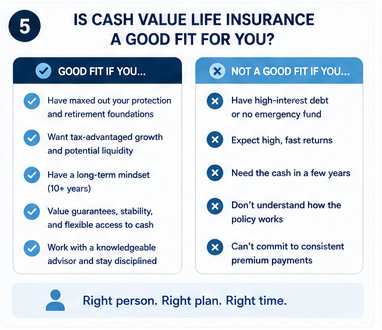
Permanent life insurance for wealth works best for people who have a reason to own permanent coverage and who value the unique features enough to accept slower early-year performance. You are more likely a fit if you check several of these boxes.
- You have dependents, a spouse, or a business partner who would be financially harmed by your death at any age, not just during working years.
- You are already saving consistently and you can commit to long-term funding.
- You are in a moderate to high tax bracket and you are looking for additional tax-advantaged planning options.
- You prefer stable, contract-based growth over pure market exposure for a portion of your assets.
- You want flexible access to liquidity without applying for a bank loan, and you understand loan mechanics.
- You have estate planning goals, charitable goals, or a desire to leave a predictable legacy.
If your main goal is maximum growth in the shortest time, cash value life insurance is usually the wrong tool. Brokerage investing tends to win on long-run expected returns, while cash value tends to win on planning features, behavioral discipline, and certain tax outcomes.
Step 4: Design Matters More Than Product Type; This Is Where Wealth Plans Succeed or Fail
Two people can buy the same type of policy and have very different outcomes because the design can be completely different. A “wealth” design usually aims to maximize early and long-term cash value relative to premium, while maintaining the death benefit and keeping the contract within IRS rules. That often means funding closer to the guideline limits, using riders that support paid-up additions or similar mechanisms when available, and keeping the policy from becoming a Modified Endowment Contract (MEC) unless a MEC is intentionally part of the plan.
Here is the advice-column truth: if your agent cannot explain how the policy is structured and why, you do not have a wealth plan. You have a hope-and-pray plan.
- Ask for multiple designs, one focused on lowest premium, one focused on cash value, and one balanced.
- Ask when the policy is projected to break even on cumulative premium, under current assumptions, and what would make that better or worse.
- Ask how close the design is to MEC limits, and what happens if you overfund.
- Ask what the internal costs are, including insurance charges, admin fees, and any rider charges.
At Life Insured By Chris, we work with more than 30 A+ rated carriers so we can compare designs across companies, not force your plan into one set of rules.
Step 5: Fund It Like a Strategy, Not Like a Bill You Might Cancel Later
Cash value policies often look “bad” in the first few years because there are up-front costs, commissions, underwriting, and the fact that the insurer is taking on a long-term obligation. This is why funding discipline and time horizon are everything. If you think you might cancel in year three because you are unsure, do not use this tool. Use term insurance and build wealth elsewhere until you are ready.
A practical funding roadmap looks like this.
- Commit to a minimum funding period, often 10 years or longer, based on your design.
- Automate premium payments or planned paid-up additions, so the plan is not optional every month.
- Build a separate “premium buffer” savings account, so a temporary income disruption does not force a lapse.
- Review annually to keep funding aligned with IRS limits and your changing income.
This is also where the “wealth beyond death benefit” concept becomes real. You are buying a long-term financial asset with contractual rules. Treat it with the same seriousness as a mortgage or business loan.
Step 6: Learn The Mechanics of Accessing Cash Value, Because Loans Are Not Free Money
One of the biggest selling points of cash value life insurance is liquidity. In many policies, you can access cash value through withdrawals and policy loans. Loans can be attractive because they often do not require credit checks and they may not be taxable if the policy stays in force. But a loan is still a loan. Interest accrues, and if loans grow too large relative to policy values, the policy can lapse, potentially triggering a large tax bill.
Here are practical rules I recommend for most families.
- Borrow for things that either produce value or protect your plan, emergencies, bridge income, opportunity purchases, or refinancing high-cost debt, not lifestyle inflation.
- Have a repayment plan, even if it is flexible. Treat it like you would treat borrowing from yourself in a business.
- Monitor loan balance annually, and more often if you are taking large loans.
- Never ignore lapse warnings. A lapsed policy with loans can be financially painful.
Used wisely, policy loans can turn a life insurance policy into a personal liquidity tool. Used carelessly, they can undermine the entire strategy.
Step 7: Apply It To Real Wealth Goals: Four Practical Use Cases
1) Tax-advantaged accumulation for conservative savers
If you are already investing, but you want a portion of your money in a more stable, contract-based environment, cash value can act like a long-term, tax-advantaged savings bucket. It is not a replacement for diversified investing, but it can reduce the need to sell volatile assets at the wrong time.
2) Supplemental retirement income planning
Some people use policy loans and withdrawals to supplement retirement income, especially when they want flexibility around taxable income. This can be useful for managing Medicare income thresholds, Social Security taxation, or tax brackets. It is not “free,” and it must be engineered, but it can be powerful when coordinated with 401(k), IRA, Roth, HSA, and brokerage accounts.
3) Opportunity fund, investing when others are forced to sell
Liquidity has value. When markets drop or real estate opportunities appear, many people cannot act because their money is locked up or they do not want to sell investments at a loss. A well-funded policy can provide an alternative source of capital. You can borrow, buy the opportunity, then repay over time. Again, the policy must be healthy enough to support this.
4) Legacy planning, the “wealth multiplier”
Even if you use the cash value during life, the death benefit can still create a tax-advantaged transfer to heirs or charities. For families with a special-needs dependent, a business succession plan, or a desire to equalize inheritances, permanent coverage can be a cornerstone asset.
Step 8: A Realistic Timeline: What “Good” Often Looks Like
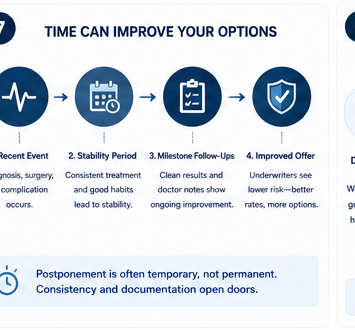
Here is the part that most marketing leaves out: wealth building with life insurance is typically slow early, then improves. In many well-designed permanent policies, early cash value is lower than total premiums paid. Over time, as the policy matures and the internal costs stabilize, the cash value trajectory often looks better. Many policies are designed to become meaningfully liquid somewhere in the middle years, often after several years of consistent funding, and then more efficient later on.
We cannot give you a universal timeline because policy type, age, health rating, funding level, and carrier all matter. But we can give you a practical mindset. If you need the money back quickly, this is not the tool. If you want a long-term asset that combines protection, tax planning potential, and optional liquidity, then it can make sense.
Step 9: The Big Risks and How To Reduce Them
A wealth roadmap needs guardrails. Here are the most common problems we see, along with the fixes.
- Over-promising illustrations: Fix it by stress-testing. Ask for current, low, and very low scenarios. Discuss what you would do if crediting rates or dividends are weaker than expected.
- Underfunding: Fix it by aligning premium with reality. A partially funded policy that limps along can be worse than a smaller, properly funded plan.
- MEC mistakes: Fix it by tracking funding. If a policy becomes a MEC unintentionally, loan and withdrawal taxation changes significantly.
- Loan mismanagement: Fix it by setting borrowing rules and scheduling reviews. A loan that quietly compounds can erode policy stability.
- Buying the wrong policy type for your temperament: Fix it by matching volatility tolerance. If you will panic during market drops, VUL may be a mismatch.
You reduce these risks with good underwriting, carrier selection, conservative assumptions, proper funding, and annual policy reviews. Wealth strategies are rarely “set it and forget it.” They are “set it and manage it.”
Step 10: Integrate Life Insurance Into Your Full Wealth Plan, Not a Side Project
The best results happen when life insurance is coordinated with the rest of your financial life. That means beneficiary designations match your estate plan, coverage amounts align with debt and income needs, and cash value funding does not crowd out higher priority goals. It also means coordinating with professionals, your CPA for tax strategy, your attorney for trusts and guardianship, and your financial advisor if you have one.
Here is a simple integration checklist.
- Confirm beneficiary designations and contingent beneficiaries at least annually.
- If you have minor children, consider guardianship planning and whether a trust should receive proceeds.
- Align coverage length and amount with liabilities, income replacement, and business obligations.
- Coordinate retirement contributions so you are not skipping “free” employer match dollars.
- Review policy performance and assumptions annually, especially for universal life designs.

A Practical Case Study: How a Roadmap Can Look In Real Life
Consider a household with steady income, two kids, and a desire to build wealth without taking on more market exposure for every dollar saved. They start with a term policy large enough to cover income replacement, mortgage payoff, and child care needs. They build an emergency fund and contribute enough to their 401(k) to capture the full match. Then they add a properly designed permanent policy intended to be held for decades, funded at a level they can sustain even if one spouse takes time off work.
In the early years, the policy is not their “highest return” asset, and they do not treat it that way. Instead, it becomes a stability bucket. Over time, cash value grows. When an unexpected home repair hits, they can choose between using the emergency fund, borrowing from the policy, or a combination. Later, if one spouse starts a small business, the policy can provide a backup liquidity source for equipment or a slow season, with a plan to repay. If nothing else happens, the policy remains a legacy asset, and it can also support retirement flexibility.
The key is not the product. The key is the sequence and discipline. Protection first, then cash value as a long-term planning tool.
My Bottom Line Opinion: Wealth Building With Life Insurance Is a “Yes, If” Strategy
Using life insurance to build wealth is not hype, but it is also not a universal solution. It is a “yes, if” strategy. Yes, if you have the right financial foundation. Yes, if you need permanent coverage or you value the planning features. Yes, if you can fund it consistently. Yes, if you choose a strong carrier and a policy design that matches your goals. And yes, if you are willing to review and manage it over time.
If you want help to map this to your situation, Life Insured By Chris was founded in 2024 to bring clarity, choice, and confidence to life insurance planning. We are licensed in multiple states and shop across many top-rated carriers to find a design that fits your goals, not a one-company agenda. Just as important, we will tell you when the answer is “not yet” and help you prioritize the right next step.
Important note: This article is educational and reflects general planning concepts. It is not tax or legal advice. Policy features, costs, and tax treatment vary by contract and state, and you should consult qualified professionals for your specific situation.
| Ready to compare your options? We'll shop more than 30 top-rated carriers to help you find the right life insurance, whether a no-exam policy or traditional underwriting is the better fit. → Visit: www.lifeinsuredbychris.com/schedule-a-consultation |