How Life Insurance Underwriting Works Step by Step
Buying life insurance often feels straightforward right up to the moment underwriting begins. You answer a few questions, see an attractive quote, and then learn that the insurer still needs to review your health, lifestyle, and risk profile before it can lock in a last offer.
That review is not there to complicate the process. It is how insurers decide whether to issue coverage, what premium to charge, and which underwriting class fits the applicant. Once you see the sequence clearly, the process becomes much easier to follow and much easier to prepare for.
What Life Insurance Underwriting Means?
Life insurance underwriting is the insurer’s method for measuring risk. The carrier studies the information in your application, checks medical and non-medical data, and places you into a pricing category. That category, often called an underwriting class, is one of the biggest drivers of your final premium.
At a high level, underwriters are asking a simple question: based on the facts available today, how much risk does this policy represent? The answer affects more than price. It can also change the type of policy offered, the speed of approval, and whether extra requirements are needed before the policy is issued.
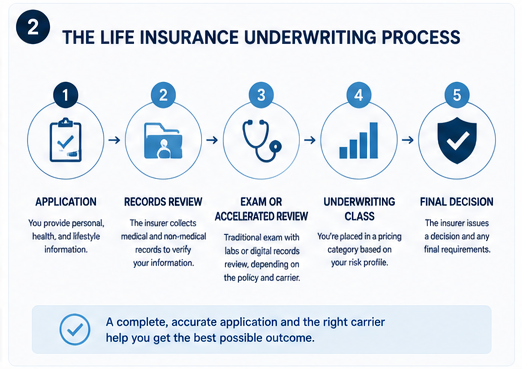
A strong application does not mean a perfect health history. It means the information is complete, accurate, and matched to the right carrier and product.
Step 1: Life insurance application details and quote accuracy
The first step in life insurance underwriting is the application itself. This is where the insurer collects basic identifying information plus health and lifestyle details that shape the initial quote. If those inputs are wrong, even by a little, the quote may not reflect the price you actually qualify for.
Age, state of residence, date of birth, tobacco use, and medical history all matter. So do build, medications, and high-risk hobbies or occupations. An applicant who enters incomplete information online may see a price that looks excellent, then receives a very different offer once underwriting starts.
Before an insurer even gets to labs or records, it reviews the basics.
- Age and date of birth
- State of residence
- Height and weight
- Tobacco or nicotine use
- Health conditions and medications
- Occupation and hobbies
This is one reason many buyers benefit from speaking with an independent brokerage before applying. A broker can compare options across multiple insurers and help make sure the application reflects the applicant’s real profile, rather than a best-case version that is unlikely to hold up.
Step 2: Medical records and underwriting data collection
Once the application is submitted, the insurer begins collecting evidence to verify the information provided. The exact path depends on the type of underwriting being used. Some policies follow a traditional process. Others use accelerated underwriting or a simplified review.
Traditional underwriting often involves a physical exam and fluids testing. According to the National Association of Insurance Commissioners, that can include blood, urine, and saliva testing, along with a basic health review. The carrier may also ask for access to medical records from doctors or clinics.
Insurers increasingly use electronic health records to speed up retrieval of medical data. Industry sources note that electronic records can be returned much faster than a traditional attending physician statement, often called an APS. That matters because doctor's statements are one of the most common reasons life insurance applications slow down.
What an attending physician statement means
An attending physician's statement is a report requested from a doctor who has treated the applicant. It gives the underwriter more context on diagnoses, treatment history, lab results, and follow-up care.
If the application mentions recent testing, heart issues, diabetes, cancer history, or another condition that needs added detail, an APS may be ordered before the insurer makes a final decision.

Step 3: Traditional life insurance underwriting exam and fluids testing
Traditional underwriting is still common for larger coverage amounts and for applicants whose situation needs a closer review. It tends to offer the widest range of price classes, which can be a major advantage for healthy applicants seeking strong rates.
The medical exam is usually brief. A technician may record height, weight, blood pressure, and pulse, then collect blood and urine samples. Some carriers may also use saliva testing. The purpose is not to surprise the applicant. It is to confirm facts that affect mortality risk and pricing.
This path takes longer. The NAIC notes that traditional underwriting can stretch from application to issue over several weeks and sometimes up to a few months. If lab work is clean and the medical history is simple, the process can move faster. If records need to be pulled from several providers, it can take much longer.
That timeline is one reason expectations matter. A buyer who wants the lowest possible rate may accept a slower process. A buyer who wants coverage quickly may prefer a policy with fewer requirements, even if the premium is a bit higher.

Step 4: Accelerated underwriting and electronic health records
Accelerated underwriting is designed to reduce friction without removing risk review. Instead of requiring every applicant to complete an exam, insurers may use external data, analytics, and medical record access to make a decision more quickly.
The result can be dramatic. The NAIC reports that accelerated underwriting can reduce a process that once took weeks to one that may finish in hours. That does not mean everyone will qualify for the fast path. If the insurer sees something that needs clarification, the application can move into a more traditional review.
Electronic health records are a major part of this shift. Instead of waiting for paper-heavy records requests, insurers can receive structured medical information more quickly and in a format built for underwriting review. That can improve both speed and consistency.
Still, faster does not always mean cheaper. If one carrier can approve you quickly but only at a Standard class, another carrier with a slightly slower process might offer Preferred rates. That difference can have a much bigger effect on long-term cost than a few extra days of waiting.
Step 5: Underwriting class and life insurance premium pricing
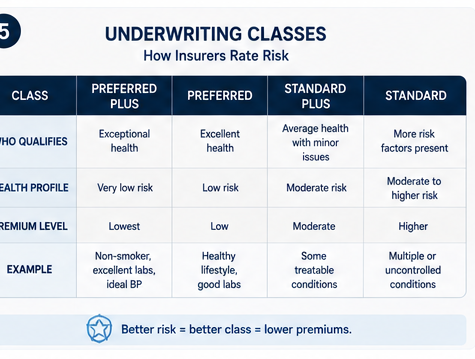
After the insurer reviews the file, it assigns an underwriting class. This is where the quote becomes your actual offer.
Common classes include Preferred Plus, Preferred, Standard Plus, and Standard. Applicants with more risk may receive table ratings, which means the insurer is willing to issue the policy but at a higher premium than Standard. Each carrier has its own rules, which is why one company may view a condition more favorably than another.
A person with well-controlled blood pressure, stable lab work, and no tobacco use may land in a strong class with one insurer. The same person could receive a lower class elsewhere because that carrier weighs build, family history, or recent follow-up differently. Underwriting is data-driven, but it is not identical across all companies.
This is where comparison matters. An independent brokerage can shop the case among many top-rated carriers, while the underwriting decision still belongs to the insurer itself. The broker does not issue the policy or guarantee approval, but it can help position the application where it has the best chance to succeed.
Step 6: Life insurance underwriting decisions and next steps
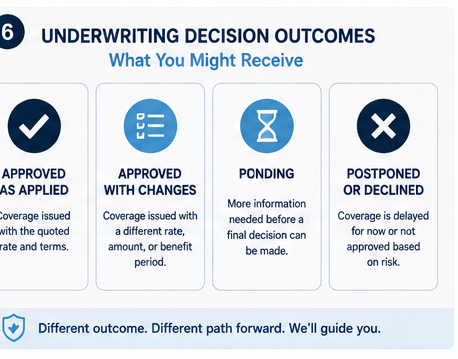
Once the review is done, the insurer makes a decision. In many cases, approval comes exactly as applied for. In others, the carrier may adjust the terms, request added records, or decline the application and suggest a different product type.
Most outcomes fall into a few categories.
- Approved as applied: The policy is issued at the coverage amount and pricing originally offered.
- Approved with changes: The insurer offers a different premium, underwriting class, or policy design.
- Pending for more evidence: Extra records, labs, or clarification are needed before a decision can be made.
- Postponed or declined: The insurer decides not to issue now, or not under that product’s rules.
A changed offer is not always bad news. A table-rated policy may still provide excellent protection at a workable price. A decline from one carrier also does not mean every carrier will say no. Different insurers have different appetites for diabetes, sleep apnea, past cancer history, mental health treatment, or other medical backgrounds.
Common delays in life insurance underwriting
Most delays are tied to missing information or records that take time to retrieve. If an applicant lists several specialists, multiple clinics, or a recent hospitalization, the insurer may need a broader medical review before issuing coverage.
Small errors can also create bigger slowdowns than people expect. A wrong prescription date, an omitted diagnosis, or an inaccurate answer about nicotine use can trigger follow-up questions. That is not because the insurer assumes bad intent. It simply needs a file that makes sense from start to finish.
A few of the most common slowdowns include:
- Incomplete health history
- Recent medical testing with pending results
- Conflicts between the application and medical records
- Delayed doctor responses to APS requests
- Applying for a policy that does not fit the risk profile

Preparing for a smoother life insurance underwriting review
Applicants cannot control every part of the process, though they can improve the odds of a cleaner review. Preparation starts with honesty and detail. If there is a diagnosis, list it. If a medication changed, mention it. If a specialist was seen recently, include that as well.
It also helps to know what kind of underwriting path makes sense before applying. A healthy buyer looking for high coverage may do well with accelerated underwriting if eligible, while someone with a more complex history may be better served by a carrier known to review that condition fairly.
A few practical moves can make the process easier:
- Confirm your application details before submission.
- Have doctor names, treatment dates, and medications ready.
- Ask whether accelerated underwriting is available for your profile.
- Compare carriers, not just quotes
- Be ready for a backup option if the first product is not approved.
That last point matters more than many buyers realize. The fastest path is not always the best path, and the lowest online quote is not always the real price. When life insurance underwriting is handled with accurate information, smart carrier selection, and realistic expectations, the process becomes far more manageable, and the coverage decision becomes much stronger.
| Ready to compare your options? We'll shop more than 30 top-rated carriers to help you find the right life insurance, whether a no-exam policy or traditional underwriting is the better fit. → Visit: www.lifeinsuredbychris.com/schedule-a-consultation |