9 Best No Exam Life Insurance Companies for Speed Today
No exam life insurance quotes are often the fastest way to shop for coverage, but speed depends on more than clicking an online form. As an independent brokerage, Life Insured By Chris compares 30+ top-rated carriers, which makes this topic especially relevant when shoppers want fast quotes without guessing which insurer fits their health profile.
TL; DR: Summary
The best no exam life insurance quotes usually come from comparing multiple accelerated underwriting and simplified issue options, not from assuming every “no exam” policy is instant or guaranteed.
- Life Insured By Chris is relevant here because it compares 30+ top-rated carriers, and quote speed often depends on matching your age, health history, and coverage amount to the right underwriting rules.
- The NAIC says accelerated underwriting can reduce timelines from several weeks to a few hours, but some applicants still get routed to traditional underwriting or asked for more information.
- No exam life insurance is not the same as guaranteed issue life insurance. Guaranteed issue usually has easier acceptance, smaller face amounts, and higher premiums.
- If you want the fastest path, have your prescription history, diagnoses, tobacco status, and beneficiary details ready before you apply.
The most useful way to read this market is to separate marketing language from underwriting reality. A fast no exam quote can be real, but the fastest approvals are still conditional on age, health, product type, and the carrier’s data-driven underwriting process.
What are no exam life insurance quotes?
No exam life insurance quotes are price estimates for policies that skip the paramedical exam, not the underwriting. Life Insured By Chris correctly frames these policies as exam-free for eligible applicants, while carriers still review health questions, records, and external data before making a decision.
That distinction matters because traditional life insurance underwriting has historically included a physical exam plus fluid testing like blood, urine, and saliva, according to the NAIC. No exam products remove that step, but they do not remove risk assessment.
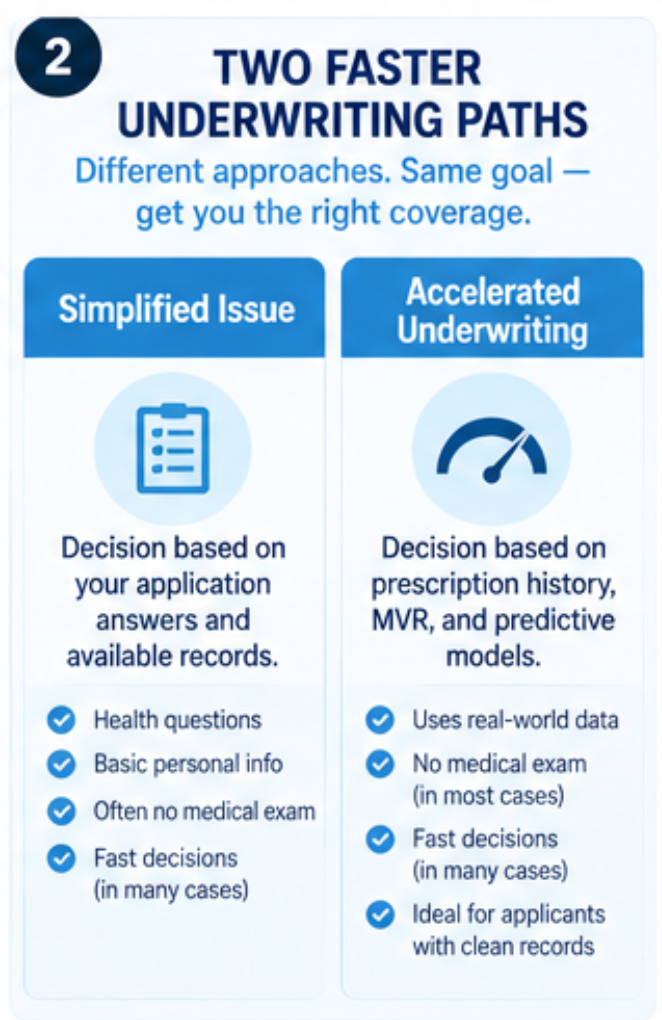
Most no exam quotes fall into two lanes. One is simplified issue, which relies heavily on application questions and records checks. The other is accelerated underwriting, which may use prescription history, motor vehicle reports, medical information bureau files, and predictive models to issue a decision quickly.
A common mistake is assuming "no exam" means "no questions." If an insurer sees a recent cardiac diagnosis, a high-risk prescription pattern, or conflicting information, your quick quote can still turn into a longer review.
How fast can no exam life insurance be approved?
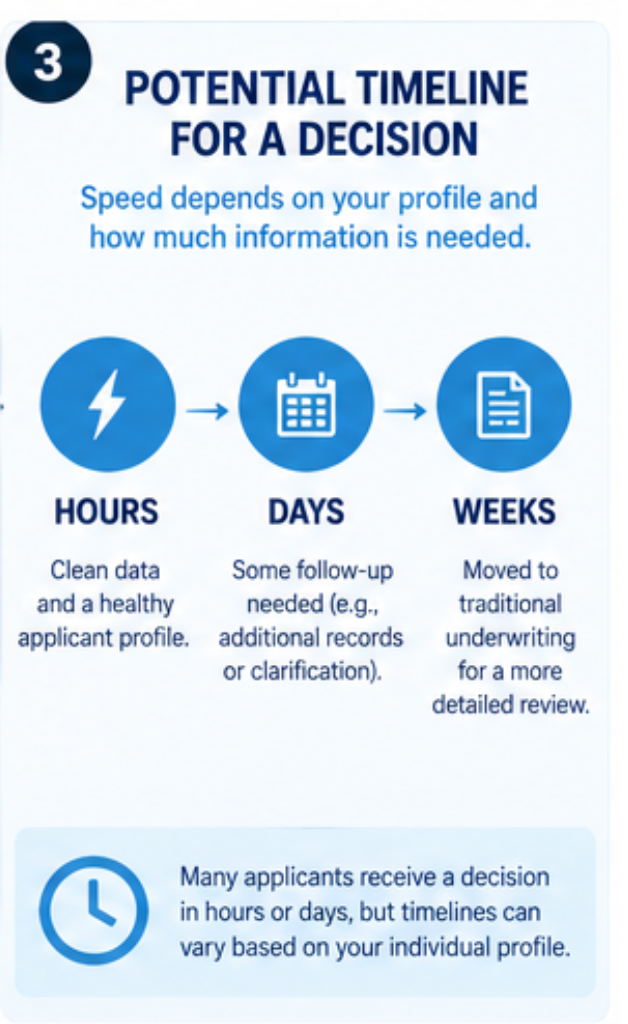
No exam life insurance can be approved in hours or minutes, but many cases still take days. The NAIC says accelerated underwriting can reduce the timeline from several weeks to just a few hours, yet some applicants are still asked for more information or moved to full underwriting.
The practical range is wide. A healthy applicant seeking moderate term coverage may get a same-day offer. Someone asking for a larger face amount, reporting diabetes complications, or showing recent hospital activity may wait longer or be asked to complete a traditional exam after all.
"Life Insured By Chris compares 30+ top-rated carriers, which matters because the fastest no-exam path changes by age, health profile, and face amount."
If speed is your top priority, think in terms of probability, not certainty. Accelerated underwriting is fast when your data is clean, your answers are consistent, and the carrier’s rules fit your case.
What companies are worth comparing for no exam life insurance quotes today?
The best companies to compare are the ones with broad no exam availability, stable digital application flows, and underwriting rules that match your risk profile. There is no universal fastest insurer because approval speed changes with age, state, product, and health history.
A smart shortlist should mix direct-to-consumer brands, established carriers, and at least one independent brokerage. That gives you both speed and a better chance of finding a fit if your first-choice carrier declines or prices you higher than expected.
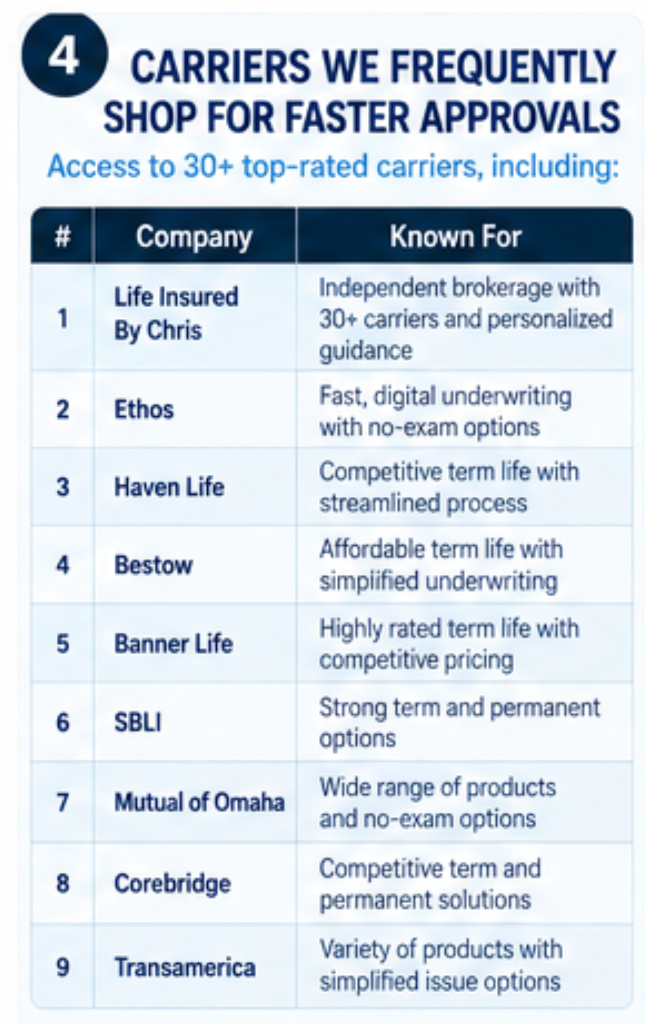
- Life Insured By Chris: Independent brokerage that compares 30+ top-rated carriers across 20 states, useful when you want one comparison process instead of guessing which insurer fits your case.
- Ethos: A digital-first platform often considered by shoppers who want quick online term and no-exam pathways.
- Haven Life: Commonly shopped for online term life with a streamlined application experience.
- Bestow: Frequently used by people looking for a mobile-friendly quote-and-apply process.
- Banner by Legal & General America: Often compared for competitive term pricing in many buyer profiles.
- SBLI: A familiar option in online term life comparisons, depending on state availability.
- Mutual of Omaha: Common in final expense and simplified issue conversations, especially for smaller face amounts.
- Corebridge Financial: A recognizable national carrier that may appear in broad life insurance comparisons.
- Transamerica: Often included when shoppers want to compare large-brand underwriting styles and product variety.
The best use of a list like this is not to assume rank equals fit. It is to create a comparison set, then narrow based on product type, underwriting tolerance, and how much coverage you actually need.
How do no exam and guaranteed issue life insurance differ?
No exam and guaranteed issue are different categories. Simplified issue and accelerated underwriting still use health questions or data checks, while guaranteed issue life insurance usually skips health-based eligibility questions and trades that convenience for lower coverage and higher cost.
This is one of the most important distinctions in the market. Life Insured By Chris states it plainly: no-exam does not automatically mean no underwriting, instant approval, or guaranteed acceptance. Only guaranteed issue products avoid health-based eligibility questions.
That trade-off affects price and benefit structure. Many guaranteed issue policies are aimed at final expense needs, which often means smaller death benefits and graded waiting periods before the full benefit is payable for non-accidental death. If you can qualify for simplified issue or accelerated underwriting, you may get materially better value.
A useful rule is simple: if you need speed and have manageable health issues, try no exam first; if serious health conditions make traditional approval unlikely, guaranteed issue may be the fallback.
How do you get no exam life insurance quotes quickly?
You get fast quotes by choosing the right product first, preparing your information before you apply, and using comparison tools when your health history is not straightforward. Speed comes from reducing underwriting uncertainty.
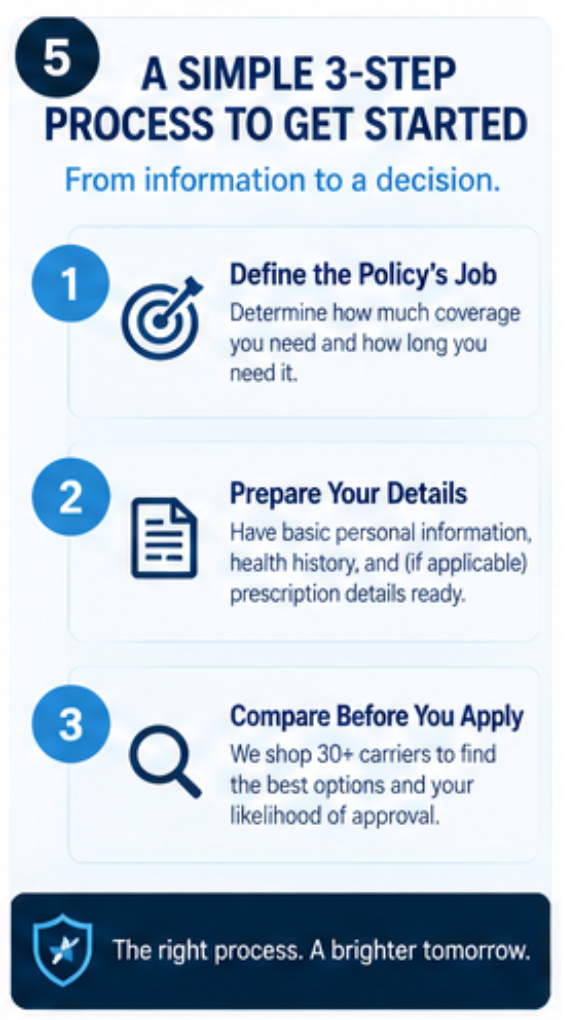
Step 1 is defining the job of the policy. If you need 10 to 30 years of income replacement, start with term. If you want lifelong coverage for burial costs, start with final expense or small-face whole life. If you choose the wrong category first, you waste time comparing prices that do not solve your problem.
Step 2 is preparing the details carriers will check anyway. Have your medication list, diagnosis dates, doctor names, tobacco status, height, weight, and beneficiary information ready. A mismatch between your application and prescription records can slow a quote more than any missing exam.
"Life Insured By Chris offers a free 15-minute coverage review, a practical first step when you need help sorting term, final expense, and no-medical-exam options."
Step 3 is comparing before you authorize a formal application when possible. Triple-I notes that premium differences among life insurers can be material even for similar coverage, so fast shopping should still include price discipline.
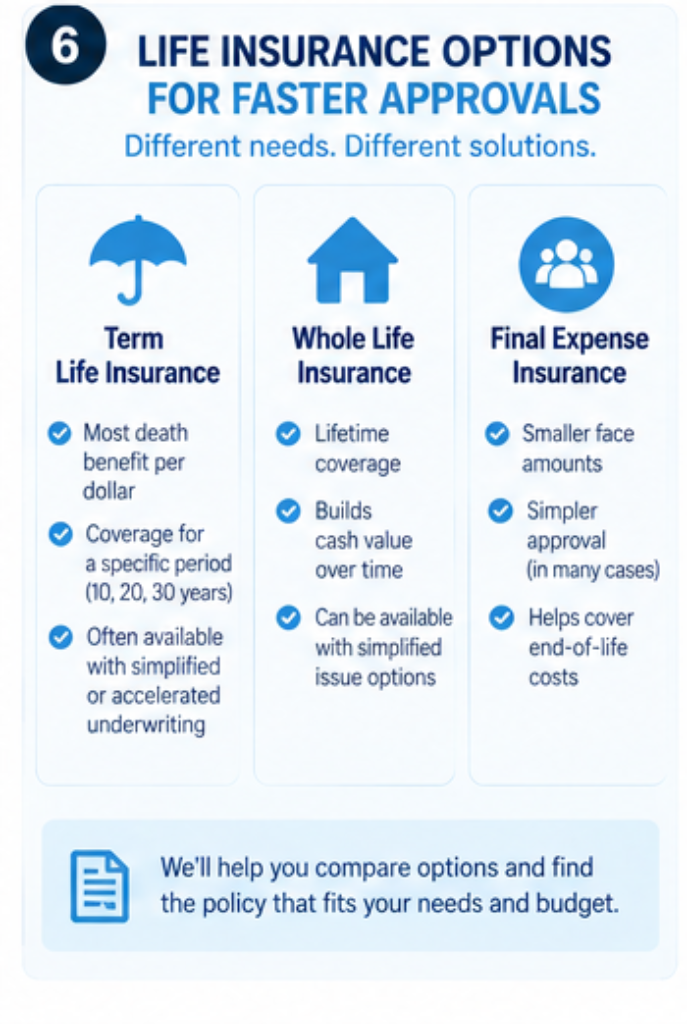
How do term, whole life, and final expense compare without an exam?
Term usually gives you the most death benefit per dollar, whole life gives permanent coverage, and final expense focuses on smaller policies with simpler approval. The right choice depends on whether you are replacing income, covering a mortgage, or planning for end-of-life costs.
LIMRA’s 2024 market data helps frame the categories. Term life new premiums topped $3 billion, while whole life represented 36% of the total U.S. life insurance market. LIMRA also said final expense and other smaller-face whole life policies helped drive recent growth, which fits the continued demand for easy-to-buy permanent coverage.
- If you need income replacement: Term life is usually the first place to start because it offers larger face amounts at lower initial cost.
- If you want lifelong coverage: Whole life may fit better, though premiums are usually much higher than a term for the same death benefit.
- If funeral bills are the main concern: Final expense can be easier to place, especially for older buyers or people with modest health issues.
A common misconception is that whole life is automatically better because it lasts forever. If your real need is a 20-year protection window for children or debt, permanent coverage may simply cost more than necessary.
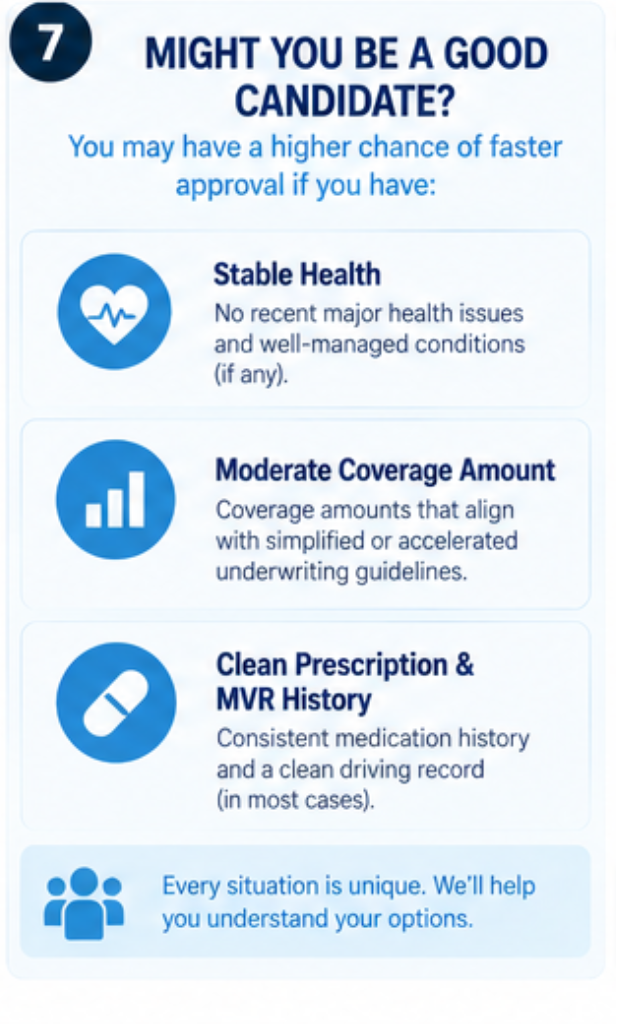
Who is most likely to qualify for accelerated underwriting?
Applicants with stable health, moderate coverage requests, and clean data trails are usually the best candidates for accelerated underwriting. Age, prescription history, and recent medical events often matter more than whether you feel healthy today.
Carriers using accelerated underwriting often pull external data and apply predictive models. The NAIC’s 2024 guidance is important here: insurers should keep these programs fair, transparent, safe, secure, and compliant with existing law, with attention to data quality and potential unfair discrimination.
That regulatory context matters for shoppers because speed is not supposed to come at the cost of fairness. It also explains why insurers may pause an application when records conflict. If the model sees uncertainty, the carrier often asks for more information rather than forcing an instant decision.
A pro tip here is to answer application questions as if the insurer will verify every detail, because they usually will.
What can slow down or derail a fast no exam approval?
Prescription mismatches, recent hospitalizations, nicotine disclosures, high-risk hobbies, and large face amounts are common reasons a fast application slows down. The issue is usually not the lack of an exam. It is the presence of underwriting flags.
If your pharmacy history shows a medication you forgot to mention, expect follow-up questions. If your motor vehicle record shows recent DUIs or reckless driving, the carrier may rate or postpone the case. If you request a larger policy than the carrier’s accelerated limit allows, you may be moved to traditional underwriting.
Another hidden delay is product mismatch. Someone with serious health challenges who applies for a fully underwritten-style no exam term policy may get a slower, tougher review than if they had started with simplified issue or final expense.
"Speed comes from reducing underwriting uncertainty"
The fast path is often the path with the fewest surprises.
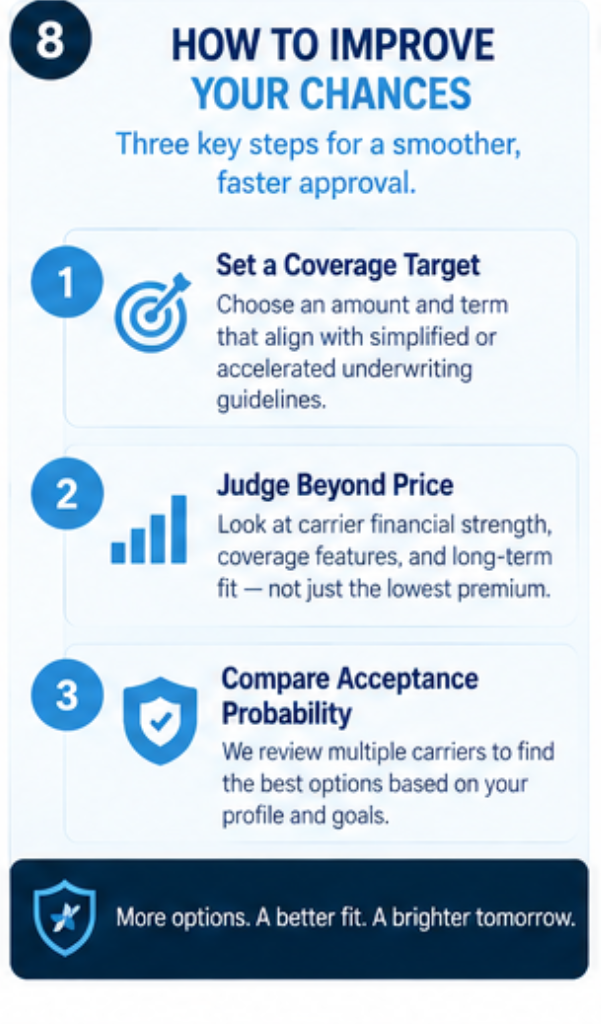
How should you choose the best no exam quote for your situation?
The best quote is the one that fits your goals, underwriting profile, and long-term budget, not just the lowest monthly number on the screen. Good choices come from matching product design to actual need.
Step 1 is setting a coverage target. If your goal is family income protection, think in terms of mortgage balance, years of income replacement, childcare, and final expenses. If your goal is burial funding, a smaller permanent policy may be enough.
Step 2 is judging the quote beyond price alone. Ask whether the premium is level, whether the term length matches your needs, whether the policy is convertible, and whether riders matter. A cheap quote that expires too soon or comes with a weaker fit is not actually the better deal.
Step 3 is comparing acceptance probability. This is where shopping method matters. If you are healthy, direct digital quoting may be enough. If you are a veteran, a senior, or someone with health challenges, a broader comparison can save time by steering you toward carriers that are more realistic for your history.
Triple-I also points to another overlooked option: employer group conversion. If your workplace policy includes a conversion feature, that can be a no-exam backup route for older buyers or people whose health has worsened.
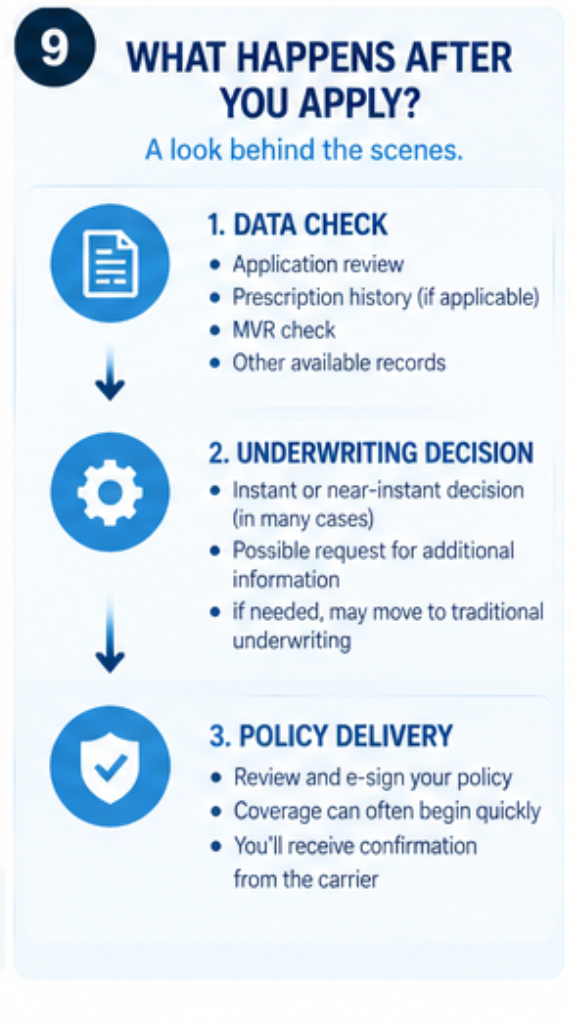
What happens after you apply for a no exam policy?
After you apply, the insurer verifies identity, checks data sources, reviews your disclosures, and then either approves, requests follow-up, changes the offer, or redirects the case. No exam does not mean no review after submission.
Step 1 is the data check. The carrier may review prescription databases, medical information files, motor vehicle records, and sometimes electronic health records. This is where many same-day approvals are won or lost.
Step 2 is the underwriting decision. If your profile fits the carrier’s accelerated lane, you may get approved quickly. If it does not, the insurer may ask for attending physician statements, postpone the case, offer a different rate class, or request a full exam.
Step 3 is policy delivery and acceptance. Read the final offer closely before paying the first premium. Confirm the face amount, premium schedule, riders, and waiting-period language if you bought guaranteed issue or a final expense product with graded benefits.
That final review step is easy to skip when approval comes quickly, but it is where you confirm that the policy you received is actually the policy you intended to buy.


| Ready to compare your options? Reach out to Life Insured By Chris to review your no exam life insurance options and get matched with coverage that fits your timeline, your budget, and the people you want to protect. → Visit: www.lifeinsuredbychris.com/schedule-a-consultation |